




The Misplaced Volcano Mystery
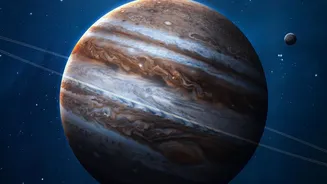
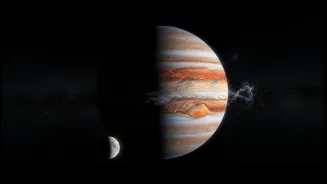
Io is a world caught in a gravitational tug-of-war. Squeezed and stretched by the immense pull of Jupiter and its neighboring moons, Europa and Ganymede, Io’s interior churns with friction. This process, known as tidal heating, generates tremendous heat,
making Io a volcanic wonderland. For a long time, scientists had solid models predicting where this internal heating should be most intense. Logically, that’s where you’d expect to find the biggest and most active volcanoes. But when they mapped Io's surface using data from probes like Voyager and Galileo, the map didn’t match the models. The majority of Io’s volcanic hotspots were offset, consistently appearing 30 to 60 degrees to the east of where they were supposed to be. This glaring discrepancy showed a fundamental piece was missing from our understanding of this fiery moon. The surface activity was clearly disconnected from the deep interior heating.
A Subsurface Solution
To explain this planetary puzzle, scientists proposed a radical idea: a vast, hidden ocean of molten rock, or magma, sloshing beneath Io's crust. Such an ocean could effectively decouple the crust from the mantle below. The tidal forces from Jupiter would still heat the deep interior, but the surface volcanoes would be fed by this subsurface sea of magma, which flows and shifts according to its own fluid dynamics. This theory elegantly explained why the volcanoes didn't align with the heating models. Magnetic field data from the Galileo spacecraft even hinted at the presence of a global conductive layer, which was consistent with a subsurface magma ocean about 30 to 50 kilometers thick. For years, this remained the leading, though unconfirmed, explanation for Io’s bizarre volcanic geography.
Juno's Deeper Look
Confirming what lies beneath the crust of a world 628 million kilometers away is no easy task. For decades, our observations of Io's heat were limited to infrared instruments that could only measure the temperature of the very top layer of the surface. But that all changed with NASA's Juno mission. During incredibly close flybys in late 2023 and early 2024, Juno came within 1,500 kilometers of Io, using a specialized tool to get the first-ever look at its subsurface temperatures. The spacecraft's Microwave Radiometer (MWR) instrument can peer through the dust and surface frost, measuring thermal emissions from several feet deep. It was an unprecedented opportunity to finally test the magma ocean theory and see where the heat was truly coming from.
Confirming Heat From Below
The data Juno sent back was revelatory. The MWR detected a significant temperature increase just a few feet into the crust, a gradient far too steep to be explained by sunlight warming the surface. This was the smoking gun: heat was undeniably rising from below, powering Io's volcanism from within its shallow subsurface. The findings, published in the Journal of Geophysical Research: Planets in July 2026, provided the first direct observational evidence of this subsurface heating process. The new data also revealed another surprise: apart from its towering mountains, large swathes of Io's surface are remarkably smooth, composed of low-density material. This suggests widespread resurfacing from lava flows, consistent with the intense heat simmering just below.
An Ocean or a Sponge?
While Juno's findings confirm a hot and active subsurface, they have also deepened the debate about its structure. Is it a single, planet-girdling magma ocean, or something more complex? The new data, combined with gravity measurements, has led some scientists to question the simple global ocean model. The emerging picture is of a world with a partially molten interior that might be more like a 'magma sponge' than a pure ocean—a matrix of deformable rock saturated with pockets and channels of melt. This model could explain both the widespread volcanism and the existence of massive, interconnected eruptions that have been observed. Instead of a single answer, Juno’s data suggests that multiple processes, including both deep mantle heating and shallow magma flows, are at play. What was once a theory is now a field of active discovery, as scientists use this data to build a more accurate picture of the most volcanic world in the solar system.