




A Star’s Final Act
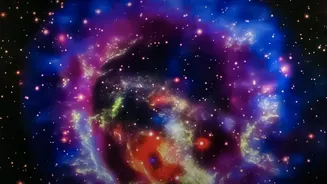
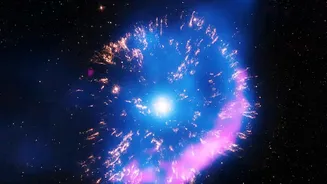
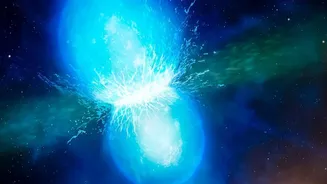
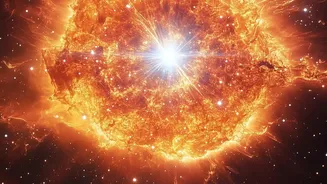
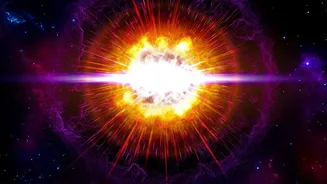
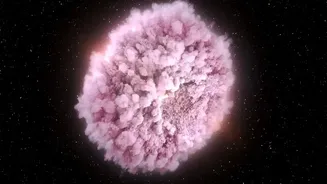
When a star more than eight times the mass of our Sun runs out of fuel, it can no longer support its own immense weight. Its core collapses in a fraction of a second, triggering a cataclysmic explosion known as a supernova. For a few brilliant weeks,
a single supernova can outshine an entire galaxy of billions of stars. These explosions are not just cosmic light shows; they are responsible for creating and scattering heavy elements like iron and gold across the universe. Without them, the raw materials for planets like Earth, and even life itself, would not exist. For decades, scientists have worked to understand the precise mechanics of this process, which is kickstarted by the gravitational collapse of the star's core.
The Ghost Particle's Key Role
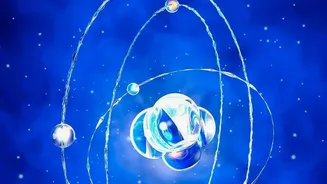
At the heart of a supernova is the neutrino, a fundamental particle so small and so reluctant to interact with other matter that trillions pass through your body every second without a trace. Because of their elusive nature, they are often called 'ghost particles'. During a star's core collapse, an almost unimaginable number of neutrinos are created—so many that they carry away about 99% of the explosion's total energy. The established theory is that while most of these neutrinos stream away, a small fraction get absorbed by the material just outside the core. This jolt of 'neutrino heating' is believed to be the crucial push that revives a stalled shockwave, powering the final, spectacular explosion.
A Surprising Identity Crisis
Neutrinos come in three types, or 'flavours': electron, muon, and tau. One of their strangest abilities is to change, or oscillate, between these flavours as they travel. A recent study from the University of Copenhagen, published on September 24, 2026, suggests this flavour-swapping can happen much more rapidly and chaotically within the ultra-dense environment of a dying star than previously accounted for. This phenomenon, known as 'fast flavour conversion', was previously thought to be a minor detail. However, new simulations show it can fundamentally alter the outcome of the star's death. The researchers found that this rapid changing of identities can significantly impact how neutrinos transfer their energy to the surrounding stellar matter.
Dousing the Cosmic Fire
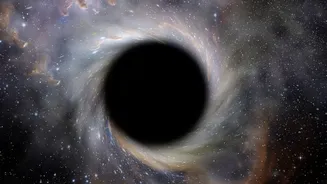
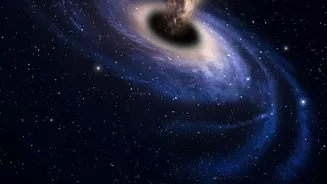
The new research shows that when these fast flavour conversions are included in simulations, the outcome for many stars changes dramatically. Instead of providing the necessary kick to cause an explosion, the altered neutrino behaviour can fail to deposit enough energy. The shockwave never gets revived. Instead of exploding into a supernova and leaving behind a dense neutron star, the star's outer layers fall back onto the core, and the entire star collapses into a black hole. This effect was particularly strong for stars between 16 and 30 times the mass of the sun. This finding could help explain a standing cosmic mystery: why astronomers observe fewer supernovae than theoretical models predict. It might be that many massive stars are not exploding, but quietly collapsing into black holes.
No Danger in Our Cosmic Neighbourhood
While the idea of a star fizzling out instead of exploding is a major shift in our understanding, the second part of the headline is crucial: this finding poses no risk to Earth. Supernova events are only considered a potential threat if they occur very close to us, generally within 100 light-years. All known stars massive enough to go supernova are much farther away than that. Whether a distant, massive star explodes or collapses into a black hole has no bearing on our planet's safety. The processes described in the study happen light-years away and are fundamental to the life cycle of stars, not a predictor of any local danger. The study simply provides a new piece of the puzzle for understanding the fates of the universe's most massive stars.