




Luxor: The World’s Greatest Open-Air Museum
Once the ancient capital of Thebes, Luxor is the essential next stop after Cairo. It’s home to a staggering concentration of monuments that can feel overwhelming in their scale and preservation. The Karnak Temple Complex, expanded by pharaohs over 2,000
years, is the largest religious building ever constructed. Its famous Hypostyle Hall, with 134 colossal columns, is a forest of stone that dwarfs visitors. Nearby, Luxor Temple is particularly stunning at dusk when its statues and colonnades are illuminated against the night sky. Across the Nile on the West Bank lies the legendary Valley of the Kings, the royal necropolis where the tomb of Tutankhamun was discovered. While it can be crowded, visiting the vibrantly decorated tombs of pharaohs like Seti I offers an unforgettable glimpse into the ancient Egyptian belief in the afterlife.
Aswan: A Tranquil Journey on the Nile
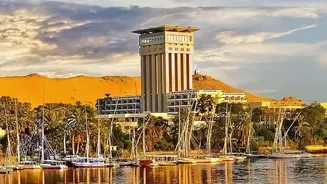
Further south, the pace of life slows in Aswan. This city, Egypt's ancient southern frontier, is the perfect place to relax while still being surrounded by history. The star attraction is the Temple of Philae, dedicated to the goddess Isis. Rescued from the rising waters of the Nile and moved to Agilkia Island, its beautiful reliefs and serene island setting make it one of Egypt's most picturesque temples. Aswan is also the starting point for a traditional felucca sail on the Nile, a timeless experience that allows you to see the landscape as ancient Egyptians once did. Don't miss the Unfinished Obelisk, a massive monument that cracked before it could be raised, offering a fascinating look into the quarrying techniques of the pharaohs.
Abu Simbel: A Feat of Ancient and Modern Engineering
The twin temples of Abu Simbel, built by the great pharaoh Ramesses II, are an icon of ancient power and a must-see for any serious traveler. Carved into a solid rock cliff face, the main temple is guarded by four colossal statues of the pharaoh himself. What makes Abu Simbel even more remarkable is its modern story: in the 1960s, the entire complex was carefully dismantled and relocated to higher ground to save it from the rising Lake Nasser. The journey from Aswan is long—typically a 3-4 hour drive each way or a short flight—but seeing the sun rise over these magnificent structures is an experience that justifies the effort. Most tours depart very early in the morning to beat the desert heat and crowds.
Alexandria: Egypt’s Greco-Roman Jewel
For a complete change of scenery, head to the Mediterranean coast to explore Alexandria. Founded by Alexander the Great, this city has a distinctly Greco-Roman feel. Instead of pharaonic temples, you'll find unique sites like the Catacombs of Kom El Shoqafa, a multi-level necropolis that blends Egyptian, Greek, and Roman motifs. Stand in awe of Pompey's Pillar, a towering Roman triumphal column, and explore the impressive Citadel of Qaitbay, a 15th-century fortress built on the site of the legendary Lighthouse of Alexandria, one of the Seven Wonders of the Ancient World. The city is also home to the Bibliotheca Alexandrina, a stunning modern library built to commemorate the original Great Library of Alexandria.
For the Dedicated Explorer: Abydos and Dendera
If you're willing to venture further off the beaten path, a day trip from Luxor to the temples of Abydos and Dendera offers huge rewards. These sites see far fewer tourists, allowing for a more intimate experience. Abydos, one of ancient Egypt's oldest holy cities, is home to the Temple of Seti I, which contains some of the most finely carved and well-preserved reliefs in all of Egypt, including the famous Abydos King List. The Temple of Hathor at Dendera is famous for its stunningly preserved ceilings, which still display vibrant blue astronomical paintings, and a rare relief portrait of Cleopatra VII. Visiting both requires a full day, but for history lovers, the pristine art and quiet atmosphere are well worth the journey.