






The Global Picture: A World of Headwinds
According to a recent global outlook report from Moody's Analytics, the world economy is entering a period of slower expansion. Global GDP growth is expected to slow to 2.5% in 2026, which is below its long-term potential. This slowdown is driven by several
factors that constitute significant 'external headwinds'. These include escalating geopolitical tensions, particularly in West Asia, which threaten to disrupt supply chains and cause energy price shocks. Added to this are uncertainties over US trade policies and persistent trade friction involving major economies like China. For a country like India, these global issues can translate into weaker demand for exports, higher costs for imported energy, and tighter financial conditions as global central banks navigate a tricky balance between growth and inflation.
India's Growth Story: A Relative Bright Spot
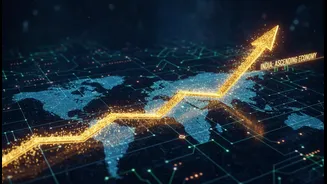
Despite these global challenges, Moody's expects India to remain the fastest-growing major economy in both 2026 and 2027. While the country's growth may moderate slightly or "lose a step" due to the global environment, its performance is projected to outshine that of China, the US, and the Eurozone. Other major economies face significant challenges, with the Eurozone's growth estimated at a mere 0.8% and Japan's below 0.5% for 2026. Even China's growth is expected to continue moderating. This positions India as a key engine of global growth, even as the overall pace of the world economy cools.
The Power of Domestic Demand
So, what is the secret to India's resilience? A major part of the answer lies in its robust domestic fundamentals. Unlike many export-dependent economies, India's growth is largely powered by strong domestic demand. Resilient household consumption, supported by a growing middle class and strong consumer confidence, provides a significant buffer against external shocks. Moody's has previously highlighted that this strong domestic consumption, coupled with supportive government policies, underpins the country's economic expansion. This internal strength means that even when global demand for its products and services weakens, the Indian economy has a large, built-in consumer base that keeps activity buoyant.
Policy, Investment, and a Tech Boost
Strategic policy-making and investment also play a crucial role. Strong public investment in infrastructure has been a key driver of economic activity. Furthermore, Moody's has affirmed India's Baa3 rating with a stable outlook, citing improving fiscal metrics and a predictable policy framework that boosts investor confidence. A new factor providing a cushion globally is the boom in Artificial Intelligence (AI). Moody's notes that investments in AI-related infrastructure like data centres have supported production and exports in several Asian economies, including India. While the gains for India from the AI boom have been more modest compared to some tech-heavy peers, it still contributes to the overall resilience.
Navigating the Risks Ahead
The outlook, while positive, is not without significant risks. Moody's cautions that the balance of risks remains tilted to the downside. A major escalation in the Middle East, for example, could lead to higher oil prices, which would be particularly challenging for India as a major energy importer. This could fuel inflation, widen the import bill, and pressure public finances. The report also highlights that a prolonged period of geopolitical uncertainty and trade disruptions could tip the global trajectory towards a sharper slowdown, or even a recession, which would inevitably have a greater impact on India's growth prospects. Therefore, while India is leading the pack, it must remain vigilant and continue to build its economic defences against these persistent global uncertainties.