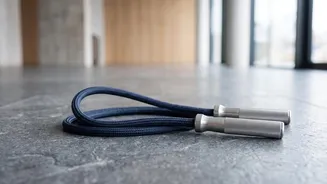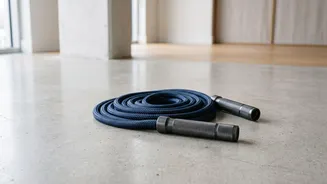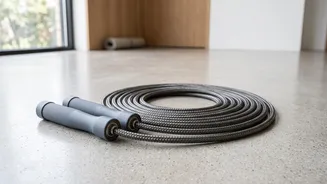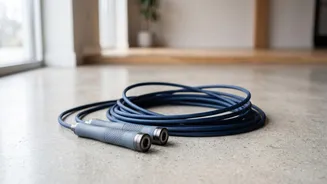





When it comes to boosting fitness, both jumping rope and running are top contenders. But if your goal is specifically to improve coordination, how do they stack up? Both exercises demand a conversation between your brain and body, but they speak different
languages.
The Rhythmic Challenge of Jump Rope
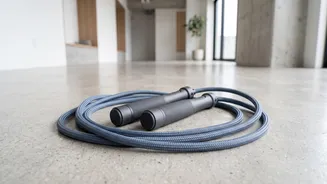
Jumping rope is fundamentally an exercise in timing. It forces your entire body into a relentless, rhythmic cycle where your hands, eyes, and feet must work in perfect synchrony. The primary demand is coordinating the circular motion of the rope, driven by your wrists, with the vertical jump of your legs. If your timing is off by even a fraction of a second, the rope catches your feet, providing immediate, undeniable feedback. This constant feedback loop is what makes jump rope such a powerful tool for developing a specific type of neuromuscular control. Your brain must learn to process the speed and position of the rope while simultaneously directing your lower body to jump at the precise moment to clear it. It’s a high-skill activity that strengthens the connection between your upper and lower body in a way few other exercises can.
The Efficient Pattern of Running
Running also requires significant coordination, but of a different nature. The core of running coordination is maintaining a stable, efficient gait over extended periods. This involves a contralateral pattern, where your right arm swings forward with your left leg, and vice-versa. This cross-body motion is crucial for balance and for countering the rotational forces generated by your legs, keeping your torso stable and your energy directed forward. While beginners can start running with little instruction, refining running form involves mastering the interplay between stride length, cadence (steps per minute), and posture. The arms don't just hang there; they set the rhythm for the legs. A proper arm swing helps regulate your cadence and ensures your lower body moves efficiently beneath you.
Upper Body Involvement: Precision vs. Momentum
Herein lies the most significant difference. In jump rope, your upper body is an active and precise participant. The work is concentrated in the wrists and forearms, which must execute small, controlled circles to keep the rope turning at a consistent speed. Your shoulders and core are engaged to maintain posture and stability against the rope's movement. Running, by contrast, uses the arms primarily for balance and rhythm. The movement is a passive swing from the shoulder, with elbows typically bent around 90 degrees. While essential for efficient form, this arm action does not require the same level of fine motor control as turning a jump rope. Therefore, for developing hand-eye-foot coordination and upper-body precision, jump rope has a clear advantage.
Lower Body Nuances: Bouncing vs. Striding
The demands on the legs also differ significantly. Jumping rope is a low-intensity plyometric exercise that involves explosive, repetitive bouncing, primarily on the balls of the feet. This action heavily recruits the calf muscles and improves the elastic strength of the Achilles tendon. The muscles work to absorb the impact and spring back up quickly. Running involves a more complex gait cycle that can include a heel, midfoot, or forefoot strike. It engages a wider range of lower-body muscles through a larger range of motion, including the glutes, hamstrings, and quadriceps, which power the body forward with each stride. While both activities build lower-body strength, jump rope excels at developing reactive power and ankle stiffness, whereas running builds endurance and strength throughout the entire leg.
The Verdict on Coordination
So, which is better for arm and leg coordination? The answer depends on your goal. If you are seeking to improve rhythmic timing, reflexes, and the precise, simultaneous coordination of your hands and feet, jump rope is the superior training tool. It’s why fighters and athletes in sports requiring quick footwork rely on it heavily. If your goal is to enhance the coordinated efficiency of your gait, improve your balance while in continuous motion, and master the contralateral rhythm that defines human locomotion, then running is your ideal choice. Running trains a more foundational, automatic form of coordination that is essential for endurance activities.