


Not Fire, Not a Rainbow
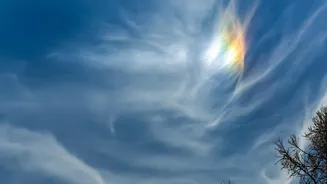
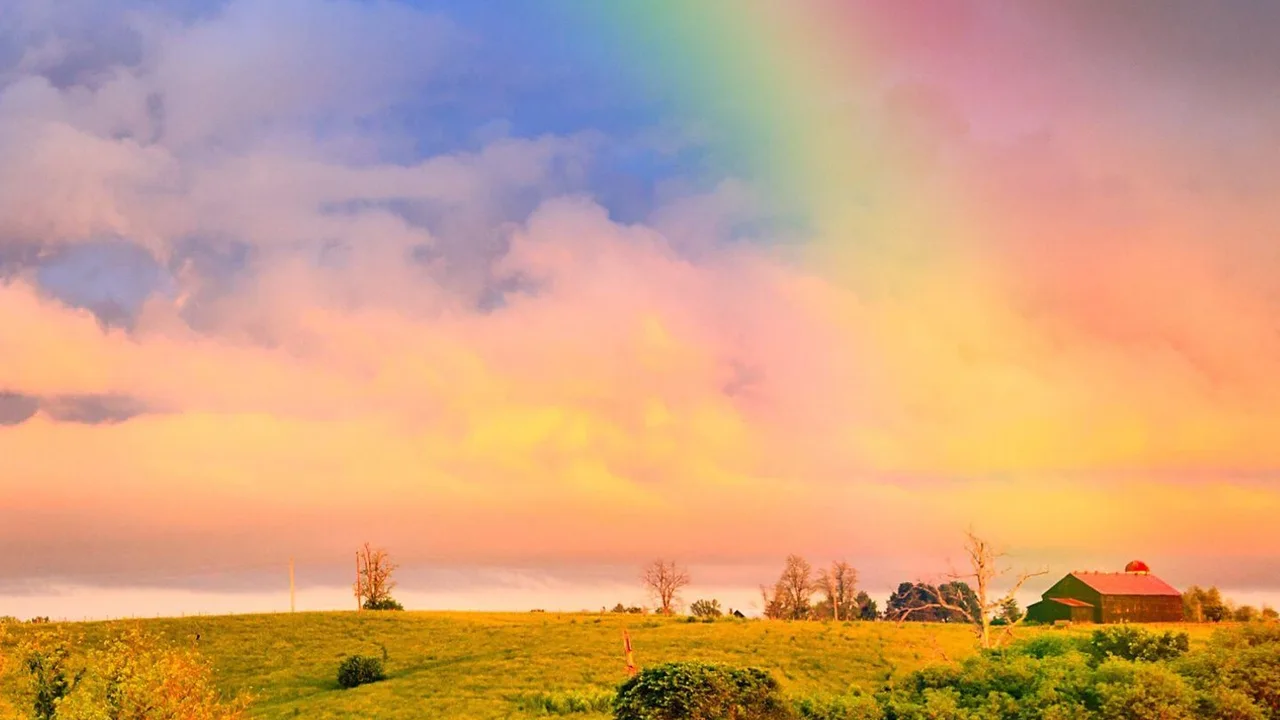
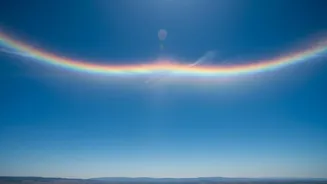
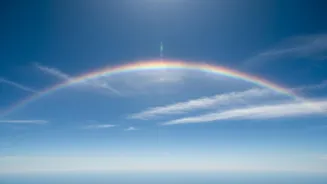
First things first: the term 'fire rainbow' is a beautiful but misleading nickname. Scientifically, the phenomenon is called a circumhorizontal arc. It gets its fiery name from its vibrant, flame-like appearance, often seen in wispy, high-altitude clouds.
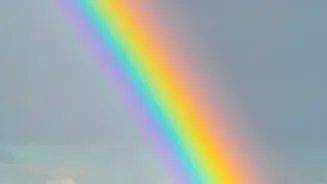
Unlike a true rainbow, which is formed by the refraction and reflection of light in raindrops and creates a full arc opposite the sun, a circumhorizontal arc is something else entirely. It’s part of a family of optical phenomena called ice halos. These arcs are flatter, broader, and run parallel to the horizon. They are created not by liquid water, but by tiny, plate-shaped ice crystals suspended in the atmosphere.
A Recipe for Celestial Light
Spotting a circumhorizontal arc is rare because the atmospheric conditions have to be just right. It’s a precise recipe that requires a few key ingredients. First, you need the sun to be very high in the sky, at an altitude of more than 58 degrees above the horizon. This is why they are primarily a mid-latitude phenomenon, most often seen during the summer months around midday, and are impossible to see in regions north of 55°N or south of 55°S. Second, you need the right kind of clouds: high-level cirrus clouds, which are thin, wispy, and composed of millions of tiny hexagonal ice crystals. For the magic to happen, these plate-like crystals must be oriented horizontally, allowing sunlight to enter through a vertical side face and exit through the bottom face. This 90-degree bend acts like a prism, splitting the sunlight into its constituent colours and creating the spectacular display we see.
Why NASA's Picture Is Special
The latest image, highlighted by NASA on August 2, 2026, as its Astronomy Picture of the Day, showcases a particularly vivid circumhorizontal arc. While the photograph itself was taken in 2021 over West Virginia, its recent feature brings renewed attention to the science of atmospheric optics. Such images are invaluable to scientists because they provide clear, real-world examples of these phenomena. They allow researchers to study the formation and behaviour of ice crystals in cirrus clouds. The clarity of the colours and the structure of the arc can offer clues about the uniformity, size, and alignment of the ice crystals, helping to refine the models that predict and explain these atmospheric events. Each new, high-quality photograph serves as a data point, helping to distinguish circumhorizontal arcs from similar-looking phenomena like cloud iridescence, which is caused by diffraction rather than refraction and can appear in different types of clouds.
A Sky Full of Illusions
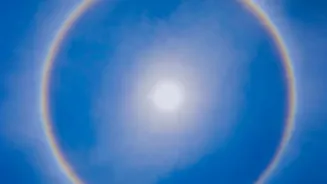
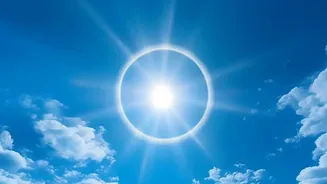
Circumhorizontal arcs are just one of many fascinating tricks of the light that happen in our atmosphere. This field of study, known as atmospheric optics, explains a whole host of celestial sights. You may have seen 'sun dogs' (or parhelia), which are bright spots of light that appear on either side of the sun, also caused by ice crystals. Another related sight is the 22-degree halo, a ring of light that forms around the sun or moon. Then there are crepuscular rays, which are beams of sunlight that appear to radiate from a single point in the sky when the sun is low. All these phenomena, from the common blue colour of the sky to the rare green flash at sunset, are governed by the way light interacts with the particles and molecules in our atmosphere.
How to Spot a Fire Rainbow
Want to see one for yourself? Your best chance in a country like India is during the summer months, when the sun can reach the required height in the sky. Look for thin, wispy cirrus clouds, especially around noon when the sun is at its highest point. Remember, the arc will appear below the sun and parallel to the horizon. While they can last for hours, they are often seen in fragments, lighting up patches of cloud with intense colour. Unlike a regular rainbow, you don't need rain—just the right combination of sun and ice. It’s a reminder that sometimes the most extraordinary sights are hiding in plain sight, requiring only a moment to pause and look up at the sky.