



A Surprising Find in the High Desert
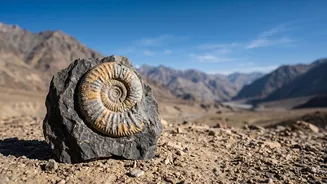
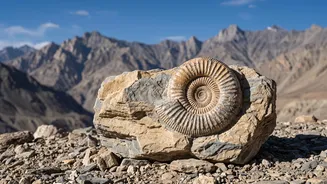
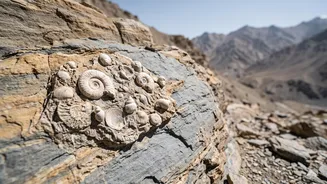
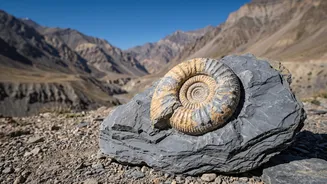
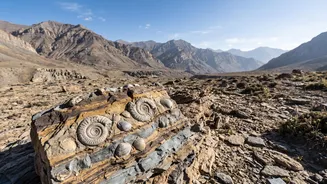
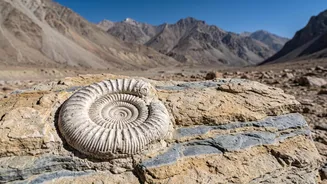
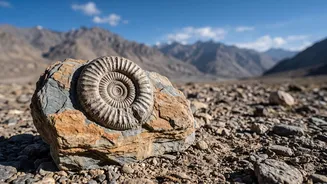
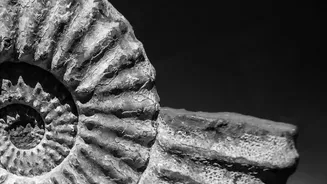
In September 2026, geologist Dr. Ritesh Arya made a remarkable discovery in Nyoma, a remote area in Ladakh's Changthang region. He unearthed a rich collection of marine fossils, including Turritella-type gastropods (spiral-shaped snails), bivalves, and
oyster-like forms. The surprise wasn't just finding fossils, but finding these specific marine types, which are strikingly similar to those found in the Subathu Formation in Himachal Pradesh. This find, at thousands of metres above sea level, immediately raised a monumental question: how did sea creatures end up on the roof of the world?
Earth 38 Million Years Ago
To understand the discovery, we have to rewind the clock to the Eocene epoch, a geological period from about 56 to 34 million years ago. During this time, the planet was much warmer, and the map of the world looked very different. India was not yet a subcontinent fused to Asia; it was a large island moving steadily northward across a vast ocean known as the Tethys Sea. This ancient ocean separated the landmasses of Asia and India. The fossils found in Ladakh are from the floor of this long-vanished sea, dating back approximately 34 to 38 million years.
The Great Continental Collision
The existence of the Tethys Sea is central to this story. As the Indian tectonic plate journeyed north, it began to collide with the massive Eurasian plate. This collision, which started around 40 to 50 million years ago, was not a sudden crash but a slow, continuous process of immense pressure. Because both continental plates were of similar density, neither would slide completely under the other. Instead, the edges buckled, folded, and were thrust violently upwards. The floor of the Tethys Sea, caught in the middle of this geological vice, was squeezed and lifted skyward, forming the beginnings of the Himalayan mountain range.
From Ocean Floor to Mountain Peak
The fossils found in Ladakh are the physical evidence of this epic geological event. The rocks that now make up parts of the Himalayas, including areas like Nyoma and even near the summit of Mount Everest, were once sediments at the bottom of the Tethys Sea. As marine creatures lived and died, their shells and remains were buried in these sediments, eventually becoming fossilized. The incredible force of the continental collision then lifted these layers of rock, containing the trapped fossils, thousands of metres into the air. Finding these marine organisms in Ladakh is direct proof that this arid, mountainous region was once a thriving coastal or shallow sea environment.
What These Fossils Reveal Today
This discovery by Dr. Arya, founder of the Tethys Fossil Museum, is more than just a curiosity. It provides crucial data for scientists. These fossils help to more accurately date the timeline of the Himalayan uplift and understand the region's ancient climate. Specifically, they suggest that the Eocene sea, known from the Subathu formation, may have extended much farther east into Ladakh than previously thought. While earlier research in the area had found freshwater and plant fossils, this large collection of marine life tells a different, broader story about the environment just before the final stages of the continental collision. Detailed study of these specimens is now underway to confirm their precise age and what they can tell us about the final days of the Tethys Sea.