




A New Eye on the Cosmos
Scheduled for launch on August 30, 2026, the Nancy Grace Roman Space Telescope is the next major astrophysics observatory for NASA. Named after the agency's first chief of astronomy, who was instrumental in bringing the Hubble Space Telescope to life,
Roman is designed to tackle some of the biggest questions in cosmology today. Its prime mission is twofold: to hunt for the secrets of dark energy and dark matter, and to conduct a massive census of planets outside our solar system, known as exoplanets. The telescope, which features a 2.4-meter primary mirror—the same size as Hubble's—was constructed at NASA's Goddard Space Flight Center and arrived at the Kennedy Space Center in June 2026 for final launch preparations. Unlike its predecessors, Roman is engineered for grand-scale surveys, promising to gather data at a rate that will transform how we map the universe.
The Power of an Infrared Panorama
Roman's superpower is its Wide Field Instrument (WFI), a 300-megapixel camera that sees the universe in infrared light. Why infrared? Much of the universe is obscured by cosmic dust, which visible light cannot penetrate. Infrared light, however, can pass through these dusty clouds, revealing the stars and galaxies hidden within. Furthermore, as the universe expands, light from the most distant—and therefore oldest—objects gets stretched out, shifting it towards the red end of the spectrum into the infrared. Roman's vision, covering wavelengths from visible light to near-infrared (0.5 to 2.3 microns), is perfectly tuned to capture this ancient light and peer through the cosmic haze. This capability will allow it to build unprecedented maps of the cosmos, providing a new window into everything from star formation to the large-scale structure of the universe.
The Hunt for Dark Energy and New Worlds
Roman's two primary science goals are ambitious. First, it will investigate dark energy, the mysterious force causing the universe to expand at an accelerating rate. By surveying millions of galaxies and thousands of exploding stars called supernovae, the telescope will measure how the universe's expansion has changed over cosmic history, providing crucial clues about this enigmatic force. Second, Roman will embark on the largest exoplanet hunt ever undertaken. Using a technique called gravitational microlensing, where the gravity of a star and its planets bends and magnifies the light from a more distant star, Roman is expected to discover thousands of new worlds. This method is sensitive enough to find planets with masses even smaller than Earth, as well as rogue planets that drift through space untethered to a star.
A Wider, Faster View
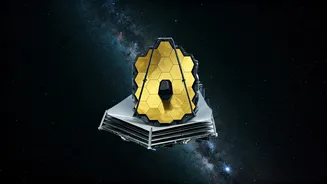
What truly sets Roman apart is its incredible field of view. Its Wide Field Instrument can capture a patch of the sky at least 100 times larger than Hubble's infrared camera in a single snapshot. To put this in perspective, Hubble would need to take hundreds of pictures to create a mosaic of the Andromeda galaxy; Roman could do it in just two. This panoramic capability makes it a survey telescope par excellence. While the James Webb Space Telescope is like a magnifying glass, performing deep, focused studies of individual objects, Roman is like a wide-angle lens, designed to map huge areas of the sky with incredible speed and efficiency. It's estimated that Roman will survey the sky up to 1,000 times faster than Hubble ever could. This efficiency will generate a flood of data—about 20 petabytes over five years—creating a vast public archive for astronomers to mine for decades.
A New Era of Discovery
The Roman Space Telescope is not a replacement for Hubble or Webb, but a powerful new partner in our cosmic exploration. Its wide surveys will identify countless new targets—from intriguing exoplanets to the earliest galaxies—for Hubble and Webb to examine in greater detail. In addition to its main survey camera, Roman carries a technology demonstration called a Coronagraph Instrument. This tool is designed to block the overwhelming glare of a star, allowing the telescope to directly image the faint planets orbiting it—a key step toward one day analyzing the atmospheres of Earth-like worlds. By combining its panoramic surveys with cutting-edge technology, Roman is poised to not only solve some of today's most profound cosmic puzzles but also to uncover entirely new questions we haven't yet thought to ask.