






India's New Watcher in the Sky
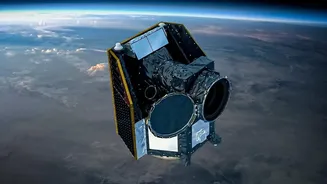
The current status of India's Earth Observation Satellite-05 (EOS-05) is that it is a resounding success. On September 4, 2026, the Indian Space Research Organisation (ISRO) successfully launched the satellite aboard a Geosynchronous Satellite Launch
Vehicle (GSLV-F17). Following the launch, ISRO performed a series of precise orbit-raising manoeuvres. The final manoeuvre was completed on September 7, 2026, placing EOS-05 securely in its intended geosynchronous orbit, approximately 36,000 kilometres above the Earth. ISRO has confirmed that the satellite's health is normal, and it is currently undergoing system checks before its advanced imaging instruments are activated.
A Game-Changing Orbit and Purpose
What makes EOS-05 so significant is its position. It is India's first dedicated imaging satellite to operate from a geosynchronous orbit. Unlike satellites in low-Earth orbit that pass over a location periodically, a satellite in a geosynchronous orbit moves at the same speed as the Earth's rotation. This allows it to continuously monitor the same large geographical area. The primary mission of EOS-05 is to provide near real-time imaging of the Indian subcontinent. This capability is invaluable for quickly monitoring fast-developing natural disasters like cyclones, floods, and forest fires, in addition to providing crucial data for agriculture, forestry, and environmental management. Furthermore, its persistent gaze offers significant strategic value for national security applications.
A Story of Resilience and Replacement
The success of EOS-05 is a story of perseverance, as it is the replacement for a mission that was lost five years ago. In August 2021, a satellite named GISAT-1 (later designated EOS-03) was lost during a launch failure. The GSLV rocket carrying it suffered an anomaly in its cryogenic upper stage, preventing the satellite from reaching orbit. The loss was a significant setback for a programme that had been in development for years. The new satellite, also known as GISAT-1A, was built to fulfil the objectives of its predecessor. Its successful launch finally delivers the advanced observation capability that ISRO has been working towards for over half a decade.
A Much-Needed Morale Boost for ISRO
The EOS-05 mission was launched at a critical time for ISRO. The agency had faced a challenging period, including an unprecedented eight-month hiatus from launches following two consecutive failures of its reliable Polar Satellite Launch Vehicle (PSLV) in May 2025 and January 2026. These setbacks raised concerns and put immense pressure on the next major flight. The flawless execution of the GSLV-F17 mission to launch EOS-05 served as both a technical validation and a major psychological boost. It demonstrated ISRO's ability to diagnose and overcome complex technical issues, reaffirming the robustness of its launch vehicle programme.
What Happens Next?
With EOS-05 now settled in its final orbital slot, ISRO engineers are conducting a series of health checks and system calibrations. This is a standard procedure to ensure all components are functioning correctly after the rigours of launch and orbit-raising. Once these checks are complete, the satellite's high-resolution and multi-spectral imaging payloads will be switched on. After this commissioning phase, EOS-05 will begin its operational life, beaming back a continuous stream of data. This will provide decision-makers, disaster management agencies, and security forces with invaluable, up-to-the-minute information to safeguard the nation and manage its resources more effectively.