

The Universe's Ghost Particle
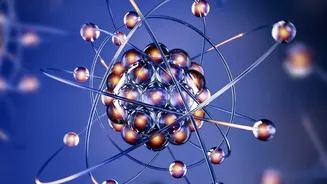
Neutrinos are fundamental particles, like electrons, but they are notoriously difficult to study. They have almost no mass and no electric charge, meaning they barely interact with other matter. Trillions of them pass through your body every second without
you ever noticing. Because they are so non-interactive, they are often called 'ghost particles'. Yet, in the most extreme environments in the universe, their behaviour becomes critically important. During the collapse of a star's core, an unimaginable number of neutrinos are created, carrying away about 99% of the energy from the explosion.
A Star's Final Moments
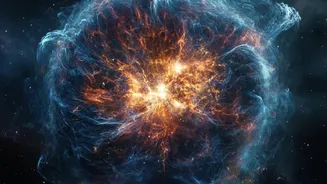
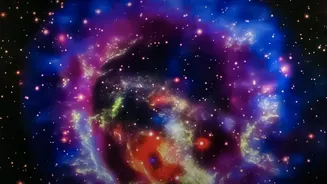
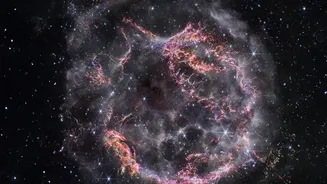
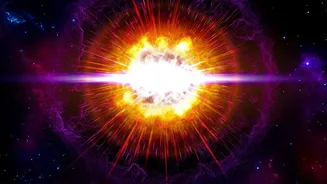
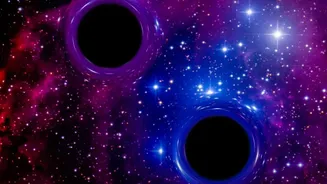
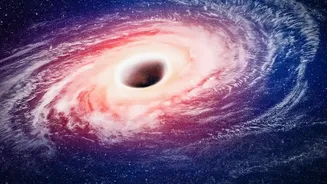
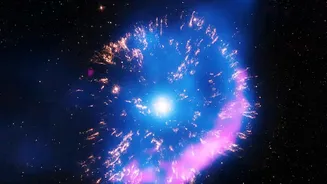
When a star many times more massive than our sun runs out of fuel, gravity wins. Its core collapses catastrophically in a fraction of a second, creating immense temperatures and pressures. This implosion triggers a shockwave. What happens next is the crucial part. Sometimes, this shockwave is powerful enough to blast the star's outer layers into space in a brilliant supernova, leaving behind an incredibly dense object called a neutron star. In other cases, the explosion fails. The shockwave stalls, and the star's material continues to fall inward, eventually collapsing into a black hole.
How Neutrinos Tip the Scales
For years, scientists believed that while neutrinos carried away energy, they didn't play a decisive role in the outcome. However, recent computer simulations from researchers at the University of Copenhagen tell a different story. Neutrinos come in three types, or 'flavors', and they can switch between these flavors as they travel. The new models show that this 'flavor conversion' is a much bigger deal than previously thought. Depending on how and where these flavor changes happen within the dying star, the amount of energy transferred to the surrounding matter can change dramatically. This change can be the difference between a successful explosion and a failed one.
Flipping a Star's Fate
The research team ran 195 simulations of collapsing stars, ranging from 9 to 120 times the mass of the sun. When they included detailed neutrino flavor conversion in their models, they saw a surprising pattern. A whole range of stars, particularly those between 16 and 30 times the sun's mass, which were expected to explode, instead collapsed into black holes. This finding could help solve a long-standing mystery called the 'supernova rate problem'—the fact that astronomers observe fewer supernovae in the universe than our theories predict. It might be that many massive stars are quietly collapsing into black holes instead of exploding.
The Power of Simulation
These discoveries are only possible because of the immense power of modern supercomputers. It is impossible to look inside a real collapsing star, so physicists must rely on complex simulations that incorporate all the known physics of gravity, nuclear reactions, and particle interactions. Adding the complex behaviour of neutrino flavor conversion is computationally very expensive, pushing these simulations to the very frontier of what is currently possible. By running thousands of these digital experiments, scientists can test how changing one small variable, like the behaviour of neutrinos, can alter the entire outcome.