





The UN Report: A Costly Delay
A new report released in September 2026 by the UN Environment Programme (UNEP) and the Climate and Clean Air Coalition (CCAC) provides a stark warning for Delhi. The study, titled 'Hidden Assets: The Economic and Health Case for Climate and Clean Air Action',
projects that Delhi could reduce its PM2.5 exposure burden by 20% by 2040 if it meets its national air quality standards on schedule from 2026. However, the report cautions that an eight-year delay in implementation—in line with expected global averages—would slash that reduction to just 10%, leading to much greater health crises. The report isn't just a critique; it identifies 25 solutions, including promoting renewable energy and stricter vehicle emission standards, that can tackle both air pollution and climate change. The core message is clear: delaying action has measurable and severe health and economic costs.
The Primary Culprits: Understanding The Pollutants
Delhi's air is a complex cocktail of harmful substances, but the most talked-about are PM2.5 and PM10. These are fine particulate matter, tiny particles that can penetrate deep into the lungs and even enter the bloodstream. PM2.5 particles are of particular concern due to their link to chronic respiratory diseases, heart issues, and other severe health problems. The Air Quality Index, or AQI, is a simplified scale used to communicate how polluted the air currently is. It synthesises data on several pollutants, including PM2.5 and PM10, into a single number with corresponding health advisories. An AQI between 0-50 is 'Good', while anything over 301 becomes 'Severe', and readings regularly cross into 'Hazardous' territory, especially during winter months.
Verified Sources Of The Smog
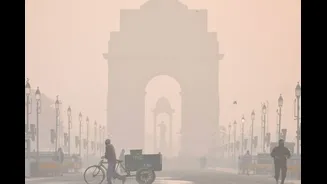
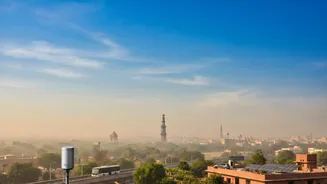
While the exact percentages can vary by season and study, there is a strong consensus on the primary sources of Delhi's pollution. A unified government report mandated by the Supreme Court identified several key contributors for winter pollution. Secondary particulates, which are tiny particles formed in the air from other emissions, are the largest single source at 27%. This is followed closely by vehicle emissions, contributing around 23%. Biomass burning, which includes both crop residue from neighbouring states and local fuel use for heating and cooking, accounts for another 20%. Road and construction dust make up about 15%. In the summer, dry conditions make dust a more dominant source, while vehicular and industrial emissions remain significant year-round contributors. A 2026 progress report on the National Clean Air Programme (NCAP) confirmed that Delhi remains India's most polluted city based on PM10 concentration.
Fact-Checking The Seasons: A Year-Round Problem
It's a common myth that Delhi's air pollution is exclusively a winter crisis, peaking around Diwali due to firecrackers and stubble burning. While winter conditions like stagnant winds do trap pollutants and worsen the smog, the problem is far from seasonal. Data from 2026 shows that even during summer months like May, PM10 levels frequently breach safe limits, primarily due to dry conditions, construction dust, and persistent vehicular and industrial emissions. For example, May 2026 saw an average AQI of 156 ('Moderate'), which, while an improvement over previous years, is still considered unhealthy by international standards. Throughout 2025 and early 2026, Delhi recorded dozens of 'Poor' and 'Very Poor' air quality days outside the peak winter season, confirming that pollution is a constant, year-round public health issue.
The Human Cost: More Than Just A Cough
The impact of breathing Delhi's air is severe and well-documented. A Washington Post analysis in early 2026 equated the toxicity of the city's winter air to smoking roughly nine cigarettes a day. The health effects go far beyond temporary respiratory discomfort. Poor air quality has been linked to irreversible lung damage in millions of children. Studies attribute thousands of deaths in the city annually directly to air pollution. The State of Global Air report from 2026 highlighted that India continues to be among the world's most polluted countries, with a significant portion of global air pollution-related deaths occurring within its borders. This data underscores that the numbers on the AQI screen translate into real-world, life-altering health consequences for millions.