

The Cosmic Life Cycle
Like all things, stars have a lifespan. For stars like our own Sun, their life is a long, stable burn powered by the nuclear fusion of hydrogen in their core. But this fuel is finite. In about five billion years, our Sun will run out of hydrogen and begin
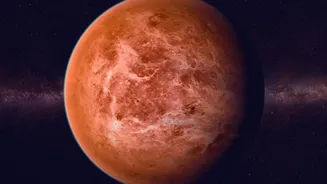
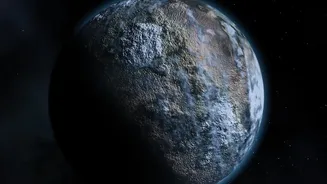
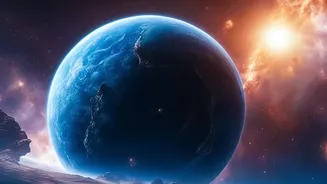
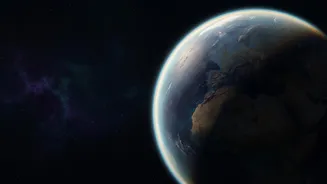
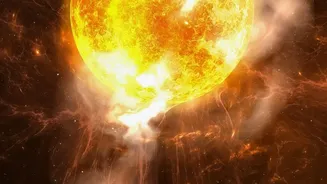
to change. It will enter its next phase, swelling into a 'red giant'. As it expands, its outer layers will billow outwards, growing anywhere from 100 to 1,000 times its original size. This massive expansion means it will inevitably engulf the inner planets of our solar system. Mercury and Venus are certain to be swallowed, and Earth's fate hangs in the balance, though it will become uninhabitable long before the final plunge.
A Signal From the Stars
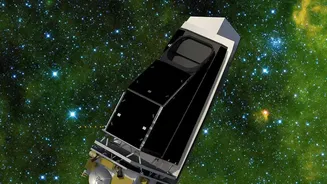
For years, this fiery end was just a prediction. Scientists had seen stars after they had likely consumed a planet, but never caught one in the act. That was until an event named ZTF SLRN-2020 was spotted around 12,000 light-years away. Astronomers at the Zwicky Transient Facility noticed a star that suddenly became over 100 times brighter over just 10 days before fading. This white-hot flash was followed by a strange, longer-lasting signal of colder material. The combination of a quick, hot outburst followed by a cool, dusty afterglow was unlike typical stellar events. It was a 'smoking gun' pointing to something far more dramatic.
From Model to Evidence
This is where theory met reality. Scientists had developed detailed models predicting what a planetary engulfment would look like, and the signal from ZTF SLRN-2020 matched perfectly. The initial bright flash was the incredible release of energy as a planet plunged through the star's atmosphere and into its core. The drag from the star's atmosphere would have slowed the planet, causing its orbit to rapidly shrink and sending it spiraling to its doom. The material seen afterwards was the stellar and planetary matter 'burped' out into space by the event, which then cooled to form dust. It wasn't a photograph of the planet falling in, but it was the next best thing: a direct detection of the precise, unique signatures that the models predicted.
An Autopsy of a Lost World
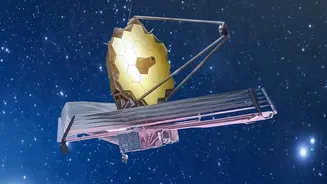
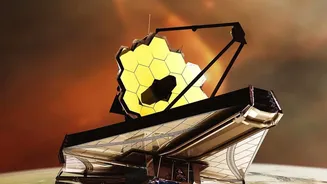
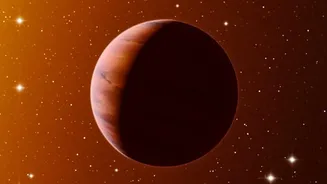
By analyzing the light from the outburst and the material that was ejected, astronomers could piece together a profile of the lost world. The energy of the event suggested the planet was a gas giant, likely between one and ten times the mass of Jupiter. The star itself is thought to be similar in mass to our own Sun. Later analysis using the James Webb Space Telescope added another layer to the story. It suggests the star didn't expand to swallow the planet, but rather that the planet's orbit decayed over a long period, bringing it ever closer until it was finally consumed. This detailed autopsy helps astronomers refine their models for how these violent events unfold across the galaxy.
A Glimpse into Our Future
Observing this cosmic spectacle is more than just an academic exercise; it’s a preview of our own solar system's distant future. The demise of this Jupiter-sized world provides the first real-world data on a process that Earth will likely face. While our planet may technically be on the edge of the Sun's final expansion zone, it will not survive unscathed. Long before the Sun engulfs it, its growing luminosity will boil our oceans and strip away the atmosphere, rendering the planet a scorched, lifeless rock. The event 12,000 light-years away is a confirmation of the ultimate fate that awaits terrestrial worlds orbiting Sun-like stars. Seeing it happen confirms a key piece of our understanding of the universe and our place within its grand, and sometimes destructive, lifecycle.