






More Than Just Taste
Salt is a fundamental ingredient in nearly all breads, and poori is no exception. While its most obvious contribution is flavor, its role extends far deeper into the science of dough. Salt is a critical component for creating the perfect texture. One
of its primary jobs is to strengthen the gluten network within the flour. When you mix flour and water, gluten proteins begin to form long, elastic strands. Salt tightens and reinforces this structure, making the dough stronger and more cohesive. This strength is essential for trapping the steam that builds up during frying, which is what causes the poori to puff up dramatically. Without a strong gluten structure, the steam would simply escape, leaving you with a flat, dense disc.
The Problem with Salty Pockets
So, if salt is so important, what happens when it's not distributed evenly? Imagine adding salt in a single clump after the flour and water have already started to combine. That concentrated pocket of salt will begin to aggressively draw moisture from the dough immediately surrounding it. This creates a small, localized area that becomes overly tight and tough, while other parts of the dough remain undersalted and weaker. These inconsistencies are the enemy of a perfect poori. The overly salted, tight sections won't stretch properly when you roll them out, potentially leading to tears. The weaker, undersalted sections won't have the structural integrity to hold the steam, resulting in poor or uneven puffing. You end up with a batch of pooris where some are flat, some are tough, and the flavor is inconsistent from bite to bite.
The Correct Technique for Even Salting
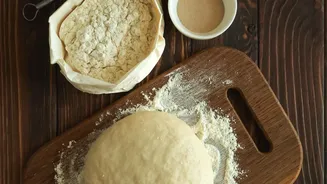
Achieving even salt distribution is incredibly simple and requires only a minor adjustment to your process. There are two highly effective methods. The first, and perhaps most foolproof, is to dissolve the required salt into the water you plan to use for the dough. By adding salted water to the flour, you ensure the salt is perfectly dispersed from the very first moment of mixing. The second method is to add the salt to the dry flour and whisk it thoroughly before adding any liquid. This ensures the salt crystals are well-separated and mixed evenly throughout the flour, preventing any clumps from forming when the water is introduced. Both techniques guarantee that every part of your dough gets the same amount of salt, leading to uniform gluten development and consistent results.
Other Secrets to Perfect Poori Dough
While even salting is a cornerstone, a few other tips can elevate your poori game. The dough's consistency is paramount: it should be firm and stiff, much more so than a chapati dough. A soft dough is more likely to absorb excess oil, resulting in greasy pooris. Don't over-knead; just work the dough until it's smooth and uniform. Another key is to let the dough rest for a short period, typically just 10 to 15 minutes. This allows the gluten to relax slightly, making the dough easier to roll without it becoming tough. Finally, when it's time to roll, avoid using dry flour for dusting. The excess flour can burn in the hot oil, leaving an unpleasant taste and dark specks. Instead, lightly grease your dough balls with a drop of oil to prevent sticking.