








NASA’s Next Great Eye on the Cosmos
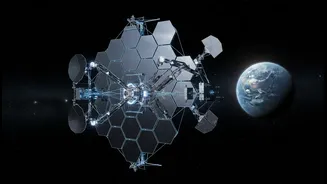
Following in the footsteps of the Hubble and James Webb space telescopes, the Habitable Worlds Observatory (HWO) is poised to become NASA's next great scientific instrument. But HWO is something different. Recommended by the National Academies, its primary
purpose is not just to see farther or deeper into the cosmos, but to do something uniquely challenging: to directly find and study Earth-like planets orbiting stars like our sun. Scheduled for launch in the 2040s, this observatory is being designed from the ground up with the specific goal of searching for the chemical signatures of life in the atmospheres of distant worlds. It’s a mission that moves the search for extraterrestrial life from the realm of science fiction firmly into the world of observational science.
Hunting for Habitable Worlds
To find a planet that might harbor life, you first have to see it. This is extraordinarily difficult. An Earth-like planet is a tiny, dim speck lost in the overwhelming glare of its parent star. HWO’s revolutionary design aims to solve this. The telescope will be equipped with an advanced internal coronagraph, an instrument designed to block starlight with a precision thousands of times greater than anything built before. By nullifying the star's light, HWO will be able to directly image rocky planets orbiting within their star’s “habitable zone”—the region where conditions could allow for liquid water. The goal is to identify and photograph at least 25 such potentially habitable worlds.
The Search for Biosignatures
Simply finding a rocky planet in the right place isn’t enough. The real prize is determining if that planet is actually alive. HWO will do this by performing spectroscopy on the light that passes through or reflects off a planet’s atmosphere. This process allows scientists to identify the chemical composition of the air on another world. They will be looking for “biosignatures”—gases like oxygen, ozone, and methane that, in the right combinations, could be tell-tale signs of biological activity. On Earth, these gases are overwhelmingly produced by life. Finding a similar atmospheric mix on a distant exoplanet would be a monumental discovery, providing the first compelling evidence that life exists beyond our solar system.
A New Kind of Mission
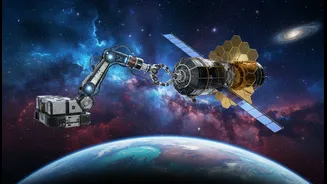
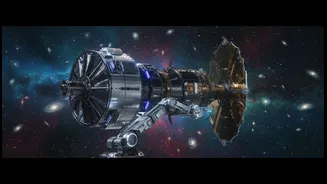
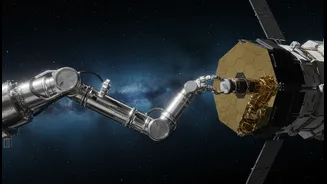
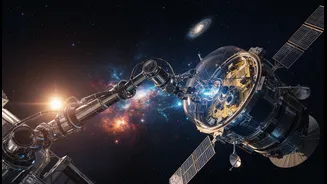
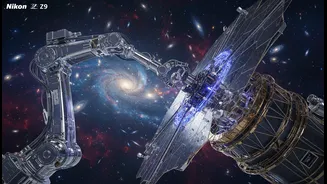
Perhaps the most significant aspect of the Habitable Worlds Observatory is not just its scientific goal, but its operational philosophy. Unlike the James Webb Space Telescope, which was launched as a single, unserviceable unit, HWO is being designed to be robotically serviced and upgraded in space. Positioned about 1.5 million kilometers from Earth, the observatory will be visited by robotic spacecraft that can perform maintenance, fix problems, and even install new, more advanced instruments decades after its initial launch. This key difference is what transforms the search for life from a single mission into a long-term, sustained campaign. It creates a platform in space that can evolve with our technology and adapt to new discoveries.
A Generational Quest Begins Now
The 2040s launch date underscores the immense technological challenge and the long-term vision required for HWO. The telescope's optical system will need to maintain stability to within the width of a single atom to achieve its goals. These technologies are being developed and tested now, with some being proven on precursor missions like the Nancy Grace Roman Space Telescope. The individuals who first conceived of HWO and are building its foundational technologies may not be the same scientists who analyze its ultimate findings. It is a generational endeavor, a baton passed from one team of engineers and astronomers to the next in pursuit of one of the most profound questions humanity can ask.