



How do you find something that's invisible? This is the central challenge for astronomers hunting black holes. But a new generation of cosmic detectives is pioneering a method that turns this problem on its head, using light to find darkness.
Hunting for Cosmic Ghosts
Black holes
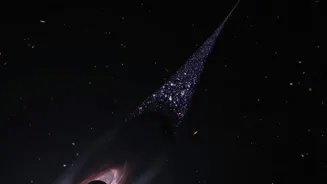
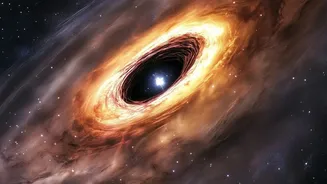
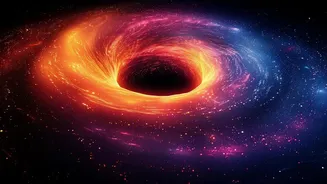
are the universe's ultimate disappearing act. Their gravitational pull is so immense that nothing, not even light, can escape once it crosses the event horizon. This makes them inherently invisible. For decades, the primary way to find a stellar-mass black hole was to look for its destructive influence on a companion star. If a star is orbiting an unseen partner and spitting out high-energy X-rays as its material is siphoned away, chances are good that its partner is a black hole. But what about the millions of black holes that are believed to drift through our galaxy alone, the solitary remnants of massive collapsed stars? These 'isolated' black holes are cosmic ghosts, and finding them requires a much subtler approach.
A Trick of Light and Gravity
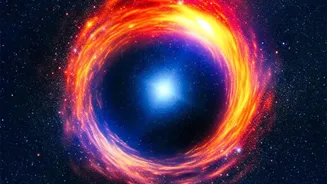
The new method relies on a phenomenon predicted by Albert Einstein called gravitational lensing. Think of spacetime as a stretched rubber sheet. A massive object like a black hole creates a deep divot in this sheet. When light from a distant star passes near this divot, its path is bent. This bending acts like a cosmic magnifying glass. If a lone black hole passes almost directly in front of a background star from our point of view, it will magnify the star's light, causing it to brighten temporarily. This fleeting change in brightness is the 'light pattern' that astronomers are hunting for. The phenomenon, known as gravitational microlensing, provides a way to detect a massive object whether it emits light or not.
The Telltale Signature
Detecting a microlensing event is a feat of patience and precision. Astronomers must monitor hundreds of millions of stars, looking for a very specific pattern: a smooth, symmetrical brightening and dimming over days, weeks, or even months. The duration and intensity of the event give clues about the mass of the invisible object, or 'lens'. A longer event suggests a more massive lens, making it a potential black hole candidate. What's more, the extreme gravity of a black hole not only brightens the background star but also slightly shifts its apparent position in the sky. Measuring this tiny astrometric shift, a task for incredibly precise instruments like the Hubble Space Telescope, can help confirm the object's mass and prove it's a black hole.
The Next Generation of Hunters
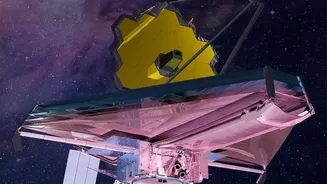
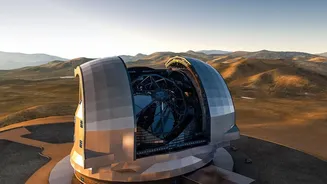
This search is being supercharged by powerful new tools. Ground-based surveys like OGLE have been instrumental in spotting potential microlensing events. ESA's Gaia space telescope, which is creating a hyper-detailed 3D map of our galaxy, can detect the telltale 'wobble' of a star that is orbiting an unseen black hole, a method that has already found several 'sleeping' black holes. Looking ahead, NASA's Nancy Grace Roman Space Telescope, set to launch in the coming years, will be a game-changer. Its vast field of view and incredible precision will allow it to conduct a massive microlensing survey, with scientists predicting it could find thousands of planets and, crucially, the first definitive population of isolated stellar-mass black holes.
Why This Search Matters
Finding these wandering black holes is more than just an astronomical treasure hunt. Scientists believe there could be millions of stellar-mass black holes in the Milky Way, but only a small fraction have been found. Locating the hidden population will provide a crucial census, helping us understand the lifecycle of massive stars and how they die. Furthermore, some theories suggest that even smaller, 'primordial' black holes might have formed in the early universe and could contribute to the mysterious substance known as dark matter. By analysing the patterns of microlensing events, astronomers hope to either find evidence for these exotic objects or rule them out, shedding light on one of the biggest puzzles in cosmology.