



A Chaotic Cosmic History
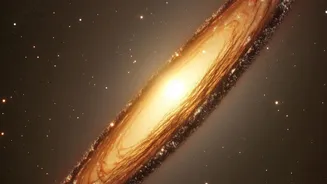
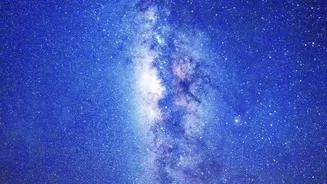
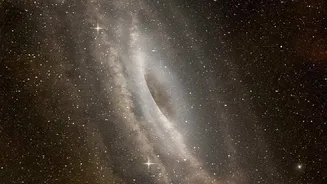
Imagine our sprawling spiral galaxy, a serene cosmic pinwheel, being violently struck by another galaxy and slowly tipping over. Recent astronomical theories propose just that. Research points to a major merger event that occurred around 11 billion years
ago, when the Milky Way was much smaller than it is today. This collision was with a now-devoured galaxy that astronomers have playfully nicknamed the "Kraken." According to this model, the impact from the Kraken was so significant that it may have fundamentally altered the structure and orientation of our galaxy over millions of years. This idea is part of a growing understanding that the Milky Way's history was not one of gentle formation but of chaotic and repeated cannibalism, absorbing numerous smaller galaxies over its lifespan.
The Telltale Clues in the Halo
The evidence for this galactic flip isn't something we can see with a simple telescope. It comes from studying the strange behaviour of objects in the Milky Way’s stellar halo. This halo is a vast, sparse sphere of ancient stars and star clusters that surrounds the main galactic disk. While stars in the disk orbit the galactic centre at high speed, astronomers noticed that the stellar halo rotates far more slowly. This discrepancy was a long-standing puzzle. The answer, theorists proposed, might lie in the orbits of globular clusters—dense, ancient balls of stars. Many of these clusters, believed to be the cores of devoured galaxies, move in peculiar ways, hinting they are remnants of past collisions. One such collision, with a galaxy called Gaia-Sausage, is thought to be a key culprit.
Unlocking the Past with Simulations
Since we cannot travel back in time to witness these ancient collisions, scientists turn to supercomputers. They use complex cosmological simulations, like the Auriga and E-MOSAICS projects, to create digital universes. These simulations model the laws of physics—gravity, gas dynamics, star formation—over billions of years. Researchers can run scenarios where a Milky Way-like galaxy collides with a smaller one. In a recent study, astronomers simulated dozens of such galaxies and found a pattern: galaxies that experienced a massive, head-on merger, like the one with Gaia-Sausage, often ended up with a slowly rotating halo. The simulations showed that the gravitational torque from such a collision could cause the entire galactic disk to gradually tilt by more than 90 degrees.
Why It's a Theory, Not a Fact
This is where the headline's crucial distinction comes in. We have direct observations of the halo's slow rotation and the odd orbits of globular clusters, thanks to data from missions like the Gaia space telescope. These are established facts. However, the explanation that a galactic flip caused this slow rotation is a simulation-backed theory. The simulation provides a plausible cause-and-effect story that neatly fits the observed evidence. It shows that a collision could lead to a flip, which could lead to a slow halo. But it is not direct proof that this sequence of events actually happened to our galaxy. It remains a compelling explanation that makes sense of the data we have, but it is not the same as observing the event itself.
The Ongoing Search for Proof
So, how can astronomers confirm this dramatic theory? The search is on for a “smoking gun”—more direct evidence left over from this ancient collision. Scientists are meticulously studying the chemistry and movements of stars in the halo to find distinct groups that can be traced back to specific absorbed galaxies like Kraken or Gaia-Sausage. Finding alternative signatures of a past disk flip would add significant weight to the claim. While the simulation provides a powerful framework, science demands corroboration. Future telescopes and larger surveys of the stellar halo will be essential in piecing together the final puzzle of the Milky Way’s tumultuous youth, potentially confirming whether our galaxy indeed performed a colossal somersault across the cosmos.