









In a landmark move for India's space programme, the responsibility for building the nation's trusted PSLV rocket is shifting from government facilities to private industry, a pivotal moment that promises to reshape the country's space ambitions.
A Landmark Agreement
A consortium
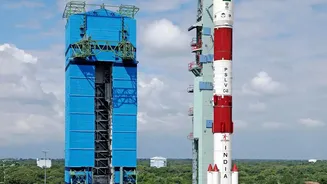
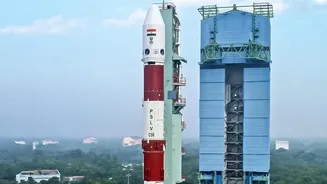
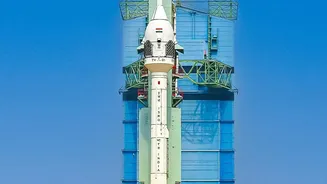
of two of India’s industrial giants, Hindustan Aeronautics Limited (HAL) and Larsen & Toubro (L&T), has been tasked with manufacturing five Polar Satellite Launch Vehicle (PSLV-XL) rockets. The contract, valued at ₹860 crore, was awarded by NewSpace India Limited (NSIL), the commercial arm of the Indian Space Research Organisation (ISRO). This agreement marks a historic transition, moving the PSLV from being assembled by ISRO with industry support to being fully built by a private consortium. While the original contract was signed in September 2022, recent updates confirm the first industry-built rocket, designated PSLV-N1, is getting ready, with its maiden launch anticipated in the first quarter of 2027. This initiative is not merely about outsourcing; it's a strategic decision to make Indian industry a prime contractor in the end-to-end production of launch vehicles.
The Titans of Indian Industry
The key players in this venture represent the pinnacle of Indian engineering and space commercialisation. Hindustan Aeronautics Limited (HAL) is a state-owned aerospace and defence behemoth, while Larsen & Toubro (L&T) is a multinational conglomerate with deep expertise in engineering and construction. Previously, these companies and others supplied about 80% of the mechanical systems and 60% of the electronics for the PSLV. This contract elevates them from component suppliers to system integrators, responsible for the entire manufacturing and assembly process. On the other side is NewSpace India Limited (NSIL), a Central Public Sector Enterprise established in 2019 under the Department of Space. NSIL's core mandate is to commercialise India's space capabilities, scale up private sector participation, and transition the space programme from a 'supply-driven' to a 'demand-driven' model. It handles everything from producing launch vehicles through industry to providing commercial launch services for global customers.
The PSLV: India's Reliable Workhorse
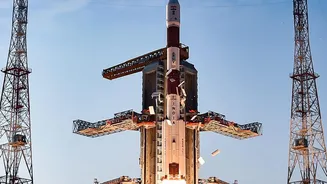
The Polar Satellite Launch Vehicle, or PSLV, is the cornerstone of India's space programme. Since its first successful flight in 1994, it has earned a global reputation for reliability and versatility, successfully completing more than 50 missions. The rocket is a four-stage vehicle capable of placing satellites into various orbits. The specific variant in this contract, the PSLV-XL, is the most powerful configuration, featuring six extended strap-on boosters that allow it to carry heavier payloads—up to 1,750 kg to a Sun-Synchronous Polar Orbit. This is the same variant that was used for India's celebrated interplanetary missions, including Chandrayaan-1 to the Moon and the Mars Orbiter Mission (Mangalyaan), proving its mettle on the world stage. Its consistency has made it the go-to launcher for not only Indian satellites but also for hundreds of foreign satellites, making it a significant source of revenue.
A Strategic Shift in Space Policy
This contract is the most tangible outcome yet of India's 2020 space reforms, designed to 'unlock' the nation's potential by opening the sector to private enterprise. The goal is to transform ISRO's role. By handing over the routine production of operational launch vehicles like the PSLV, ISRO can dedicate its formidable resources and expertise to cutting-edge research and development. This includes pioneering deep-space science missions, the Gaganyaan human spaceflight programme, and developing next-generation technologies like reusable launch vehicles. The privatisation of PSLV manufacturing is designed to significantly increase India's launch frequency. This increased capacity is crucial for deploying large satellite constellations, meeting national security needs, and capturing a larger share of the booming global commercial launch market, which is projected to grow substantially.
The Road Ahead for Indian Space Inc.
The successful delivery of these five PSLV-XL rockets will serve as a powerful proof-of-concept for India's new space ecosystem. It will validate the 'Government-Owned, Contractor-Operated' model, where private companies use ISRO facilities to build space hardware. This framework is expected to create a vibrant domestic market, fostering innovation among the over 400 space-tech startups now active in India. For HAL and L&T, this is an opportunity to become global players in the launch vehicle market. For India, it is a critical step towards its ambition of growing its space economy from around $9 billion to over $40 billion within the next decade. By building a self-reliant and competitive industrial base for space manufacturing, India is positioning itself not just as a space-faring nation, but as a global space-faring leader.