


The Universe's Growth Spurt Problem
Imagine trying to explain how a newborn baby grew to the size of a blue whale in just a few months. That’s the kind of problem astronomers face when they look at the early universe. The James Webb Space Telescope (JWST) and other observatories have found
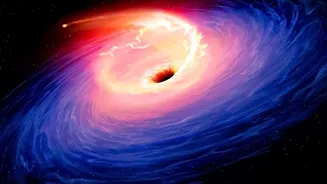
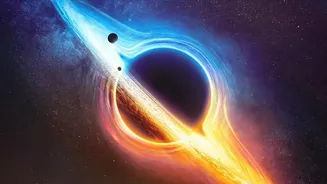
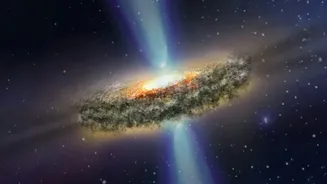
gigantic black holes, millions or even billions of times the mass of our sun, that existed when the cosmos was less than a billion years old. This timeline is baffling. According to simple models, a black hole grows by steadily consuming gas and dust, but there just wasn't enough time for them to reach such monstrous sizes through this method alone. This has left scientists with two main theories: either they were born from exceptionally massive 'seeds'—perhaps the direct collapse of huge gas clouds—or they grew through more extreme means, like merging with other black holes or feeding at impossibly fast rates.
A Glimpse into the Ancient Past
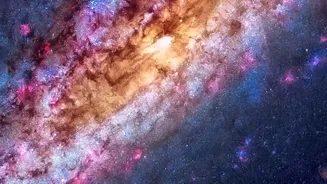
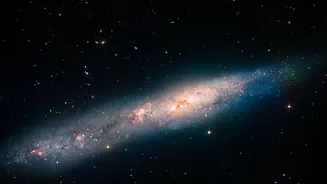
The latest clue comes from a galaxy named J0148-4214. Thanks to the power of the JWST, astronomers can see this galaxy not as it is today, but as it was about 12.5 billion years ago. This means we are observing a snapshot of the universe when it was only about 1.2 billion years old—a mere toddler in cosmic terms. An international team of researchers, led by the Max Planck Institute for Extraterrestrial Physics, pointed the telescope's powerful Near-Infrared Spectrograph at this distant object. They weren't just taking a picture; they were dissecting its light to analyze the motion of gas within the galaxy, hoping to find the signature of a growing black hole. What they found was far more than they bargained for.
An Unexpected Cosmic Crowd
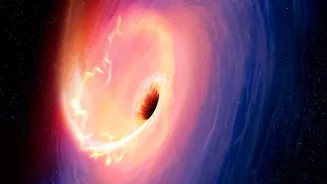
Instead of one active supermassive black hole, the data revealed the clear signatures of three. This is the first time a trio of actively feeding black holes has ever been confirmed in a single galaxy in the early universe. Two of the black holes are huddled relatively close together in the galaxy's core, separated by only about 620 light-years. A third lurks further out in the galaxy's periphery. Their masses vary wildly, estimated at approximately 80 million, 2 million, and 600,000 times the mass of our sun. Previously, astronomers looking at this galaxy with less advanced tools saw only a single, blurry source. The JWST's precision allowed researchers to resolve the scene and uncover the crowded, complex reality.
Mergers as a Black Hole Growth Engine
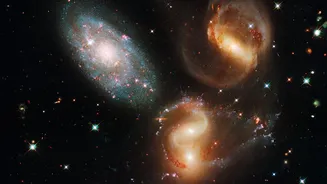
This discovery is more than just a cosmic curiosity; it provides powerful, direct evidence for a key theory of rapid black hole growth. The early universe was a chaotic place where young galaxies frequently collided and merged. These galactic pile-ups would have brought their central black holes into close proximity, setting them on a path to eventually merge and form a single, much larger object. Finding three black holes in J0148-4214 is like finding a fossil of this process in action. It suggests that these mergers were a common and efficient way for black holes to bulk up quickly. The two black holes in the center are already on a collision course that is expected to conclude within a few hundred million years, demonstrating how this growth mechanism works.
A Glutton That Breaks the Rules
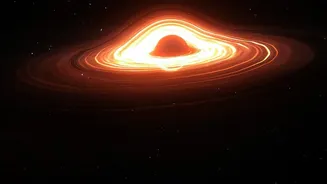
Adding another layer of intrigue, the team found that one of the smaller black holes—the one with a mass of about 600,000 suns—is feeding with astonishing ferocity. It is consuming matter at a rate that exceeds the 'Eddington limit', a theoretical speed limit on how fast a black hole can grow by accretion. This limit is set by the outward pressure of the radiation released by the infalling matter. To see an object in the early universe so clearly violating this limit shows that some early black holes were not just steady eaters but voracious gluttons, capable of short, intense bursts of growth that further accelerated their journey to supermassive status.