




The Cosmic Line-Up
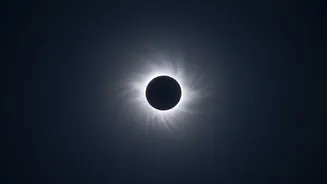
At its heart, a lunar eclipse is a straightforward alignment of three celestial bodies: the Sun, Earth, and Moon. It can only happen during a full moon, when the Moon is directly opposite the Sun in our sky. During a lunar eclipse, Earth passes precisely
between the two, casting its enormous shadow onto the lunar surface. This cosmic positioning, known as syzygy, temporarily darkens the Moon, creating a captivating spectacle for observers on the nighttime side of Earth. Unlike a solar eclipse, a lunar eclipse is perfectly safe to view with the naked eye, as you are simply watching a shadow fall upon the Moon.
A Tilted Path and Perfect Timing
If the Moon orbits Earth every month, you might wonder why we don’t have a lunar eclipse with every full moon. The reason lies in the tilt of the Moon’s orbit. The path the Moon takes around Earth is inclined by about five degrees relative to Earth’s own orbital plane around the Sun (known as the ecliptic). Because of this tilt, the full moon usually passes just above or below Earth's shadow. An eclipse only occurs when the full moon’s path intersects the ecliptic plane at the exact same time it is aligned behind Earth. These intersection points are called nodes, and this perfect alignment happens only about twice a year, making each lunar eclipse a special event.
A Tale of Two Shadows
Earth’s shadow is not uniform; it is composed of two distinct parts: the umbra and the penumbra. The umbra is the dark, central part of the shadow, where the Sun is completely blocked by Earth. The penumbra is the fainter, outer region where the Sun is only partially obscured. The type of lunar eclipse is determined by which part of the shadow the Moon passes through. If it only grazes the faint penumbra, it’s a penumbral eclipse that can be hard to notice. When part of the Moon enters the dark umbra, it is a partial eclipse. A total lunar eclipse occurs when the entire Moon is engulfed by the umbra.
The Science of the 'Blood Moon'
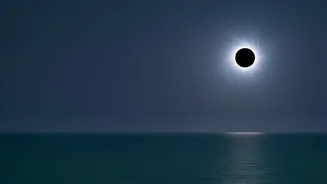
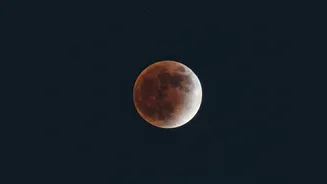
During a total or deep partial lunar eclipse, the Moon often takes on a stunning reddish-orange hue, earning it the nickname "Blood Moon." This eerie glow is not a trick of the eye but a beautiful display of physics. As sunlight passes through Earth's atmosphere, the shorter, blue wavelengths of light are scattered away by air molecules—the same reason our sky is blue. The longer, red and orange wavelengths, however, bend or refract through the atmosphere and are projected into Earth's umbra. In essence, the eclipsed Moon is being illuminated by the light of all the sunrises and sunsets happening on Earth at that moment.
The August 2026 Event: A Deep Partial Eclipse
The eclipse on August 27-28, 2026, is a particularly deep partial lunar eclipse. At its peak, up to 96% of the Moon's surface will be covered by Earth's dark umbral shadow, leaving only a tiny, bright sliver of the Moon visible. This will make it appear very close to a total eclipse, and the covered portion is expected to glow with the characteristic coppery red light. This impressive celestial event will be visible across the Americas, Europe, and Africa. For skywatchers in India, the eclipse will unfortunately not be visible as it will occur during daylight hours in the region. However, it will likely be broadcast online through live streams from observatories around the world.