


A Groundbreaking New View
The incredible new image comes from the National Science Foundation's Daniel K. Inouye Solar Telescope, perched atop Haleakalā on Maui, Hawai'i. While NASA is a key partner in solar research, this specific achievement is courtesy of the world's most powerful
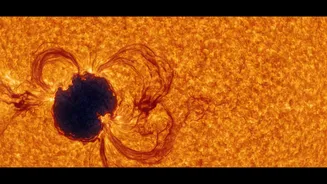
solar telescope, operated by the National Solar Observatory. The image, released on August 5, 2026, is making waves in the scientific community for its unprecedented clarity. It allows astronomers to see features as small as 12 to 20 kilometers across on the sun's surface, a resolution never before achieved. This is like being able to spot an object the size of a small town from 150 million kilometers away. The image focuses on the sun's photosphere, the visible surface where light finally escapes into space.
Decoding the Plasma Swirls
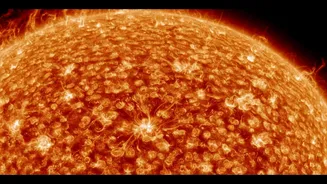
The headline feature of the image is the dramatic, swirling patterns of plasma. These are not just random movements; for the first time, scientists have direct visual confirmation of a phenomenon known as the Kelvin-Helmholtz instability on the sun's surface. You've seen this effect on Earth in the undulating patterns of clouds or when wind blows over water. It happens when two fluids or gases moving at different speeds slide past each other, creating a shearing effect that curls into vortices. On the sun, this involves super-heated plasma, and these newly visible swirls and ripples are giving scientists a direct look at the fundamental physics that govern our star’s behavior. The image also clearly shows solar granules, which are massive convection cells. Hot plasma rises in the bright centers of these cells, cools, and then sinks back down along the darker edges, creating a pattern that looks like boiling water, but on a cosmic scale. Each of these granules is typically about 1,500 kilometers across—larger than many countries.
The Technology of a Sharper Sun
Capturing such a sharp image from Earth is a monumental technical challenge. Our planet's turbulent atmosphere blurs and distorts light, which is why stars appear to twinkle. To overcome this, the Inouye Solar Telescope uses a remarkable technology called adaptive optics. Its system features a 4-meter primary mirror, the largest of any solar telescope, which collects an immense amount of light. This light is then directed to a deformable mirror, a flexible surface that is adjusted by 1,600 actuators up to 2,000 times per second. A wavefront sensor constantly measures atmospheric distortion and tells the deformable mirror precisely how to change its shape to counteract the blurring, effectively 'un-twinkling' the sun and delivering crystal-clear images.
Why This Detail Matters
Seeing the sun in higher resolution isn't just for show; it's critical for understanding and predicting space weather. The sun's magnetic fields are responsible for phenomena like solar flares and coronal mass ejections (CMEs), massive eruptions of plasma that can travel through space and impact Earth. These events can disrupt satellite communications, damage power grids, and pose a risk to astronauts. By studying the fine-scale magnetic structures and plasma flows, like the newly observed Kelvin-Helmholtz instabilities, scientists can better understand how magnetic energy builds up and is violently released. This detailed view provides crucial data to refine computer models of solar activity, which could one day lead to more accurate and timely space weather forecasts, helping us protect our increasingly technology-dependent society.