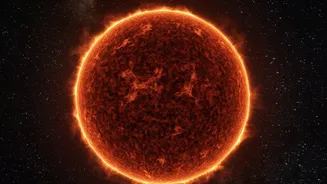







A New, Sharper View of Our Star
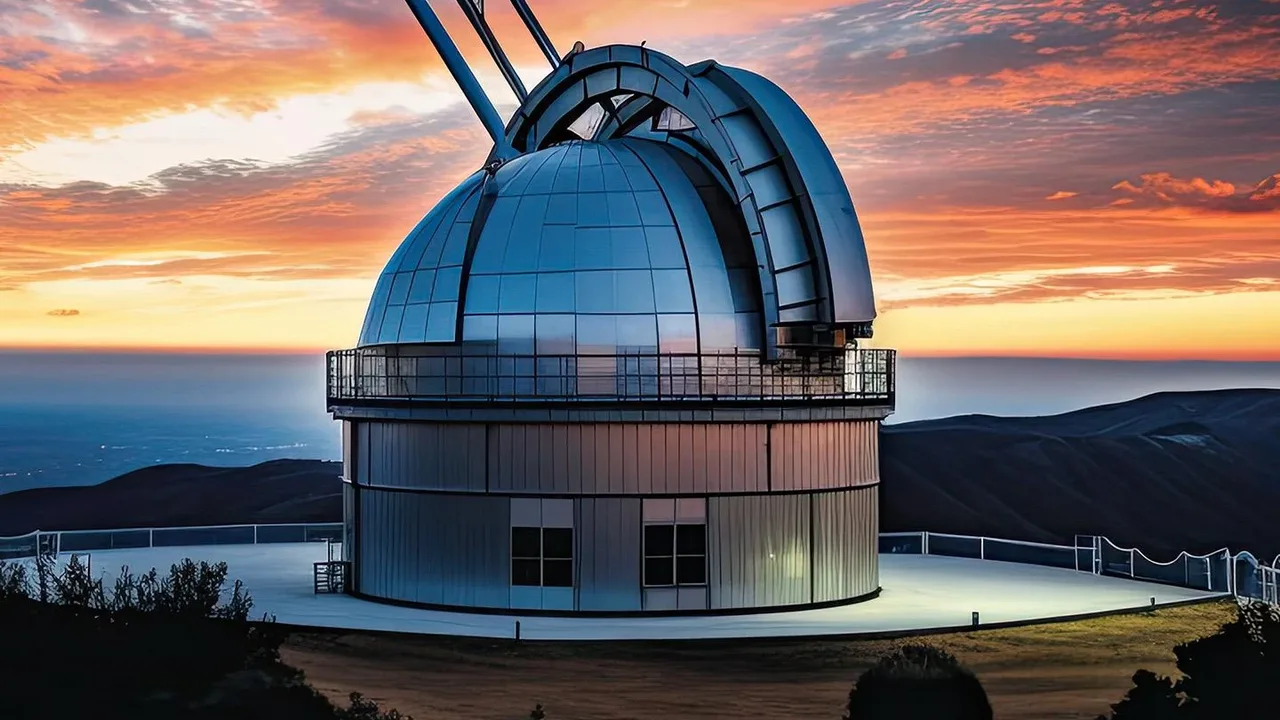
Scientists have captured the most detailed images ever taken of the sun's surface, thanks to the immense power of the National Science Foundation's Daniel K. Inouye Solar Telescope on Maui, Hawaii. These images push the boundaries of what is observable,
revealing structures as small as 19 kilometers across on a star that is 150 million kilometers away. What they found was not a smooth surface but a landscape dominated by swirling, vortex-like patterns that had long been theorized but never directly seen on the sun's visible surface, or photosphere. This discovery provides the first direct confirmation of a phenomenon known as Kelvin-Helmholtz instability, which occurs when two fluids sliding past each other at different speeds create a rippling, wave-like effect. We see this same effect in clouds and ocean waves on Earth, but observing it on the sun provides a critical new piece to the solar puzzle.
What is 'Fluid Mixing' on the Sun?
The 'fluid' on the sun is plasma—a superheated gas of charged particles so hot that atoms are stripped of their electrons. This plasma is constantly in motion, driven by the intense energy generated in the sun's core and shaped by powerful magnetic fields. The new images reveal that at the edges of magnetic areas, layers of plasma moving at different speeds slide past one another. This creates a shear that triggers the Kelvin-Helmholtz instability, causing the plasma to curl into tiny whirlpools and vortices. This process of 'mixing' is far more complex and dynamic than previous observations could detect. Researchers found that this instability is ubiquitous, happening all over the sun's surface, which suggests it's a fundamental process in how the sun operates.
Solving a Decades-Old Mystery
One of the longest-standing puzzles in solar physics is the coronal heating problem: why is the sun's outer atmosphere, the corona, hundreds of times hotter than its visible surface? The surface is about 5,700 degrees Celsius, but the corona sizzles at over a million degrees. The newly-observed mixing might be a key part of the solution. Scientists believe this turbulent churning and twisting can transport huge amounts of energy from the sun's surface up into the higher layers of its atmosphere. The Kelvin-Helmholtz instability is known to be an efficient way to spread mass and energy. By acting as a mechanism to transfer energy upwards, these thousands of tiny swirls could collectively contribute to the extreme heating of the corona.
Why This Matters for Earth
Understanding the sun's chaotic behavior isn't just an academic exercise. The same magnetic forces that cause this fluid-like mixing also power solar flares and coronal mass ejections (CMEs)—massive explosions that hurl charged particles into space. When these storms are aimed at Earth, they can disrupt our satellites, damage power grids, and endanger astronauts. By understanding the fine-scale dynamics that power the sun, scientists can build more accurate models to predict space weather. Recent advancements with other missions, like NASA's PUNCH, have already dramatically improved forecast accuracy for CMEs by providing continuous tracking. The detailed insights from the Inouye telescope add a crucial layer of understanding about the very origin of these solar events, promising a new era in our ability to forecast and prepare for space weather.