





A Heart That's Anything But Still
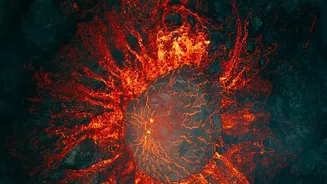
Ever since NASA’s New Horizons spacecraft flew by Pluto in 2015, scientists have been captivated by Tombaugh Regio, the planet's iconic heart-shaped feature. The western lobe of this heart, a vast basin of nitrogen ice called Sputnik Planitia, is larger
than Texas and Oklahoma combined. For years, it was clear this region was young, geologically speaking. Its surface is almost completely free of craters, indicating it's being constantly resurfaced, perhaps over less than a million years. The surface is covered in giant polygon-shaped cells, hinting that the ice was slowly churning like a colossal lava lamp. But the latest findings point to something even more dramatic.
The Surprising 'Bleeding' of Liquid Nitrogen
New analysis of the New Horizons imagery has provided the first evidence of recently flowing liquid on Pluto's surface. Researchers identified dark streaks and patches along the boundaries of the icy polygons. These features strongly resemble areas on Earth's own glaciers that have been wetted by flowing water. Of course, it’s not water on Pluto. The culprit is believed to be liquid nitrogen. Since Pluto's thin atmosphere and extreme cold make nitrogen rain impossible, scientists concluded the liquid must be coming from below the surface. It appears Pluto’s heart is, in a way, bleeding.
How Does a Frozen World Have Liquid?
The idea of liquid on a world where surface temperatures hover around minus 230 degrees Celsius seems impossible. However, computer models suggest a fascinating process. Sputnik Planitia's nitrogen ice sheet is several kilometres deep. At the very bottom, immense pressure combined with modest heat trickling from Pluto's rocky core is enough to melt the base layer of nitrogen ice. This liquid nitrogen is less dense than the solid ice above it. Buoyancy forces it upward through cracks and conduits, much like magma rising through Earth's crust. When it reaches the frigid surface, it flows for a short time before refreezing, leaving behind the dark stains that scientists have now identified.
A New Understanding of Planetary Life
This discovery fundamentally changes our perception of Pluto. It’s not a static, dead ball of ice and rock, but a geologically active world with complex subsurface 'plumbing'. The lead author of the study, Alan Stern, noted that "Pluto never stops surprising us," adding that the findings suggest a new kind of time-variable feature on the dwarf planet. This ongoing activity helps explain why the surface of Sputnik Planitia looks so young and unblemished. The constant churning and occasional seepage of liquid nitrogen effectively repaves the landscape over astronomical timescales.
What This Means for Other Icy Worlds
The implications of Pluto's active heart extend far beyond the dwarf planet itself. This mechanism could be at play on other distant, icy bodies in our solar system. For instance, similar processes might explain the mysterious geysers observed on Triton, Neptune's largest moon. It also offers a framework for understanding potential activity on other Kuiper Belt objects like Eris, should they be found to have similar nitrogen ice deposits. By studying how materials behave in the extreme environment of Pluto, scientists can better understand the full range of geological possibilities across the cosmos, revealing that even the coldest, most remote corners of our solar system can be unexpectedly alive.