







A Breakthrough in Brain-Computer Interfaces
Meta's AI research lab has announced a system called Brain2Qwerty v2, which can translate brain signals into complete sentences in real-time. The most significant aspect of this technology is that it is non-invasive, meaning it does not require surgical
implants. This sets it apart from other high-profile brain-computer interface (BCI) projects, like Elon Musk's Neuralink, which rely on surgically implanted electrodes. The primary goal is to develop technology that can help people who have lost the ability to speak due to neurological injuries or diseases, offering them a new way to communicate.
How It Works: Decoding Without Surgery
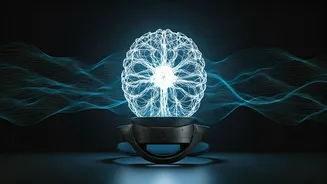
So, how does it work? The system uses a technology called magnetoencephalography, or MEG. A person wears a helmet-like device that contains highly sensitive sensors capable of measuring the tiny magnetic fields produced by the brain's electrical activity. The process involves volunteers typing sentences for several hours while wearing the MEG scanner. The AI is trained on this vast dataset of approximately 22,000 sentences, learning to associate specific patterns of brain activity with the intention to type certain characters, words, and sentences. It then uses a sophisticated, multi-layered AI model, including large language models similar to those in popular chatbots, to reconstruct the intended text from the noisy brain signals.
Impressive, But Not Perfect
The results are a massive improvement over previous non-invasive methods. Brain2Qwerty v2 achieves an average word accuracy of 61%, a dramatic jump from the 8% accuracy of prior systems. For the best-performing participant in the study, the accuracy reached an impressive 78%, with over half of the sentences decoded having one word error or less. However, this isn't flawless telepathy. The system is not reading random thoughts; it decodes the brain activity specifically associated with the act of typing. Furthermore, the AI must be custom-trained for each individual user, and the current MEG hardware is large and requires a specially shielded room, making it impractical for home use just yet.
The Promise for the Future
The potential applications are profound, especially in the medical field. For millions who suffer from conditions that impair speech, such as brain lesions, ALS, or locked-in syndrome, this technology could be life-changing. It offers the hope of restoring communication without the risks and complexities of brain surgery. Meta researchers have also noted that the system's accuracy improves with more training data, suggesting the gap between non-invasive and invasive methods could continue to shrink. By making the research code openly available, Meta hopes to accelerate progress across the fields of neuroscience and AI, potentially leading to faster diagnosis and treatment of neurological disorders.
The Urgent Ethical Questions
As with any technology that touches the human brain, this breakthrough raises significant ethical questions. The concept of 'neurorights' is becoming increasingly relevant, focusing on principles like mental privacy, cognitive liberty, and the right to control one's own neural data. Experts warn that without clear regulations, our innermost thoughts could become the next frontier for data harvesting and monetization. There are concerns about how this data would be used, who would own it, and how it could be protected from misuse or hacking. While the current technology is focused on a specific task and requires active participation, the rapid advancement in this field necessitates a proactive conversation about establishing ethical and legal guardrails to protect what is arguably our final frontier of privacy.