








A Landmark Timeline Emerges
In a significant announcement, Union Railway Minister Ashwini Vaishnaw confirmed that India’s first bullet train is slated to hit the tracks for testing by May or June of 2027. This represents the most concrete timeline provided for the operational testing of the much-anticipated
project. The trial period is expected to last between two and four months, during which the train systems will undergo rigorous evaluation before a potential inauguration. This development signals that after years of planning and construction, the project is moving from groundwork to the critical phase of operational readiness. The initial tests will focus on a specific, nearly completed section of the corridor, bringing the vision of 320 km/h train travel in India a step closer to reality.
The Project at a Glance
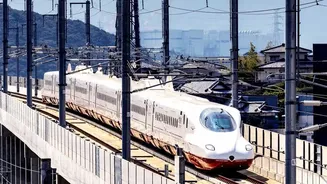
The Mumbai-Ahmedabad High-Speed Rail (MAHSR) Corridor is one of India's most ambitious infrastructure undertakings. Spanning a distance of 508 kilometres, the line will connect Maharashtra's and Gujarat’s primary economic hubs. The project is being executed by the National High Speed Rail Corporation Limited (NHSRCL) using Japan’s renowned Shinkansen technology, a system famous for its safety and punctuality. Once fully operational, the bullet train is expected to slash travel time between Mumbai and Ahmedabad from over six hours by conventional rail to approximately two hours. The corridor includes 12 stations, elevated viaducts, and even an undersea tunnel section near Mumbai, showcasing the project's engineering complexity.
Progress on the Ground
The journey to this point has been challenging, marked by initial delays primarily related to land acquisition in Maharashtra. However, officials report that these hurdles have been overcome, with all the required land for the project now fully acquired. Construction is advancing at a steady pace, particularly in the Gujarat portion of the corridor. Work on viaducts, bridges, and stations is visibly progressing. The first operational section is expected to be a stretch in Gujarat, likely between Surat and Bilimora or Surat and Vapi, with a target to be commissioned by August 2027. This phased approach will allow the service to begin on completed sections while work continues on more complex parts of the line, such as the segments in Maharashtra.
An 'Atmanirbhar' Push
While the project leverages Japanese technology, there is a strong emphasis on domestic manufacturing under the 'Atmanirbhar Bharat' mission. The first body frame of an indigenous high-speed train has already been completed and sent for crucial structural testing. Indian public sector unit BEML Limited has been tasked with manufacturing prototype trainsets. These trains, part of the 'Make in India' initiative, will be designed for speeds of around 250-280 km/h initially. This domestic production capability is not just for a single project; it is creating a blueprint for a future national network of high-speed rail corridors, aiming to standardise engineering and reduce costs for subsequent projects.
The Road to Full Service
The 2027 trial run is a test, not a final launch. This phase involves extensive checks on the rolling stock, signalling systems, tracks, and safety protocols to ensure everything functions perfectly at high speeds. It's a meticulous process designed to guarantee passenger safety and operational reliability. Following a successful trial period of a few months, the first section will be cleared for commercial services. While the first rides may happen in 2027, the entire 508 km corridor from Mumbai to Ahmedabad is expected to become fully functional later, with some estimates pointing towards 2029. This staggered commissioning is a pragmatic strategy to get the revolutionary service running as soon as possible.