




A Planet Without Plates
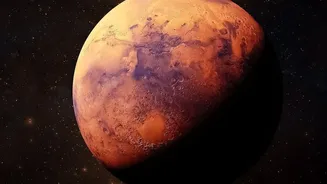
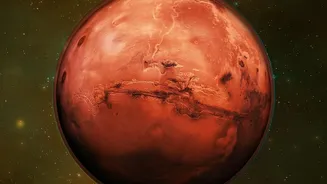
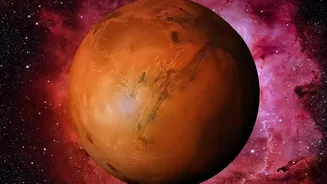
On Earth, the movement of tectonic plates drives much of our planet's geology, from building mountains to fueling volcanoes. Mars, however, is what scientists call a 'stagnant lid' planet; it lacks this system of shifting crustal plates. For years, the prevailing
assumption was that Martian volcanism must be relatively simple. Scientists believed that volcanoes like the colossal Olympus Mons were fed by isolated, vertical plumes of magma, like a candle burning under a sheet of paper. This model implied that volcanic activity was confined to specific hotspots. The planet's cold, thick crust was thought to be a major barrier, preventing molten rock from traveling very far horizontally. This picture suggested a planet with a limited ability to recycle elements or sustain the kind of complex geology we see on Earth.
Listening to the Heart of Mars
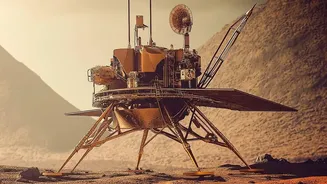
The game-changer came from an unexpected source: the seismic whispers of Mars itself. Using data from NASA's InSight lander, which recorded vibrations from 'marsquakes' and meteorite impacts, researchers peered deep beneath the surface. A team from the University of Oxford focused on a mysterious boundary located about 24 kilometres down. By analysing how seismic waves passed through this layer, they discovered it wasn't just a simple change in rock type. Their findings, published in the journal Nature Astronomy, suggest this boundary marks a region where molten rock once pooled and spread sideways, forming vast, interconnected plumbing systems of magma.
Rivers of Subterranean Fire
The new evidence points to a phenomenon known as 'transcrustal magmatism,' a complex process previously thought to be unique to Earth. Instead of isolated magma chambers, Mars may have hosted enormous, interconnected networks of molten rock stretching for hundreds, or even thousands, of kilometres across its northern hemisphere. These subterranean magma 'rivers' would have separated over time, with denser, crystal-rich material sinking to form the detected layer, while lighter, more evolved magma rose toward the surface. This completely changes our view of the Red Planet’s interior, suggesting it was capable of creating a highly evolved and chemically complex crust through intense internal recycling, all without the aid of plate tectonics.
Fuel for a Different Kind of Planet
The implications of this discovery are profound, extending far beyond geology. Such a massive volcanic system would have been a powerful engine for planetary change. The widespread movement of magma could have released enormous amounts of heat and gases like water vapour, carbon dioxide, and sulphur dioxide into the atmosphere. This process could have helped regulate the planet's ancient climate, possibly creating short-lived periods of warmth and liquid water on the surface. On Earth, this kind of geological recycling is fundamental to creating and sustaining a habitable environment. Finding evidence of similar complex processes on Mars forces us to reconsider what makes a planet potentially habitable.
New Hope in the Search for Life
Perhaps the most exciting consequence of this discovery relates to the search for extraterrestrial life. One of the key ingredients for life as we know it is liquid water, and another is a source of energy. These vast magmatic systems provide a compelling mechanism for both. As rivers of magma moved through the crust, they would have inevitably encountered Mars's abundant subsurface ice. The intense heat would have melted this ice, creating vast hydrothermal systems—warm, water-rich environments protected from the harsh radiation on the surface. These are precisely the kinds of settings where microbial life could have potentially thrived. This new understanding widens the areas on Mars that could have once supported life, giving future missions new and tantalizing targets to explore.