








A Groundbreaking 'All-Weather' Eye in the Sky
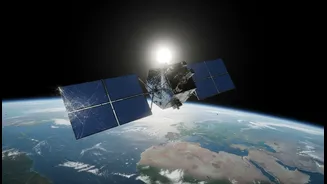
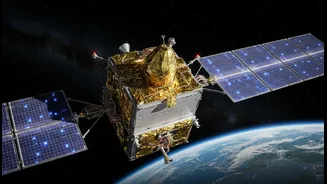
Launched on May 3, 2026, aboard a SpaceX Falcon 9 rocket, Mission Drishti was not just any satellite; it was the world's first OptoSAR satellite. Developed by Bengaluru-based startup GalaxEye, this 190 kg spacecraft was designed to do something no other
satellite had done before: combine optical and Synthetic Aperture Radar (SAR) imaging on a single platform. Optical sensors work like a camera, capturing clear, color images but are useless in clouds or darkness. SAR, on the other hand, uses radar waves to see through clouds, smoke, and at night, but its images are less intuitive. By fusing these two technologies, Mission Drishti promised all-weather, day-and-night imaging, a capability with massive implications for defence surveillance, disaster management, and agriculture. Hailed as a milestone by both the Prime Minister and ISRO, it was India's largest privately built satellite and a symbol of the country's growing prowess in space technology.
What Went Wrong?
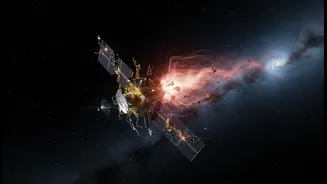
After a successful launch and initial phase where it established communication and validated key systems, Mission Drishti ran into trouble. During the final stage of its Launch and Early Orbit Phase (LEOP), a critical period where the satellite is commissioned, it was hit by a severe geomagnetic solar storm. GalaxEye officially announced on July 7 that an anomaly occurred following the storm. Initial analysis suggests that radiation from the event likely damaged a critical onboard system. Communication with the spacecraft became sporadic before being lost entirely. While recovery efforts are technically ongoing, the company has stated that the likelihood of re-establishing contact is low.
The Culprit: A Geomagnetic Solar Storm
A solar storm is a violent eruption from the Sun that flings a cloud of energized plasma and radiation into space. When this storm hits Earth's magnetic field, it triggers a geomagnetic storm. For satellites, especially those in Low Earth Orbit (LEO) like Mission Drishti, these storms pose several dangers. The energy can heat the upper atmosphere, causing it to expand. This increases atmospheric drag on satellites, causing their orbits to decay faster. More critically, the storm's radiation and charged particles can build up on satellite surfaces, leading to electrostatic discharges that can fry sensitive electronics. In this case, it appears the radiation dealt a fatal blow to a key system on Mission Drishti, effectively silencing it.
A Costly Lesson for India's Space Ambitions
The loss of Mission Drishti is more than just the failure of one satellite; it's a significant setback for India's private space sector. The mission was a trailblazer, intended to prove the commercial viability of homegrown, cutting-edge space technology and reduce India's reliance on foreign satellite imagery. However, the team at GalaxEye is framing the event as a source of invaluable, albeit harsh, learning. The company's CEO, Suyash Singh, stated that the mission provided engineering insights that will directly strengthen future projects. GalaxEye has already announced plans to incorporate these learnings into its next-generation spacecraft, aiming to launch two new OptoSAR satellites within the next 24 months and bring more of its manufacturing in-house to ensure greater control over quality and reliability.
A Wake-Up Call for a Satellite-Reliant World
This incident serves as a stark reminder of the vulnerability of our increasingly space-dependent infrastructure. From GPS navigation and communication to financial transactions and weather forecasting, modern life runs on satellites. The solar storm that likely disabled Mission Drishti is not an isolated event. In February 2022, a similar, even moderate, storm led to the loss of up to 40 newly launched Starlink satellites. As solar activity waxes and wanes in its natural 11-year cycle, the threat of powerful storms remains constant. The loss of Mission Drishti underscores a growing challenge for all space-faring nations and companies: how to build more resilient technology and improve space weather forecasting to protect the vital orbital assets that underpin our global economy and security.