







A Tale of Gods, Demons, and Immortality
The core belief traces back to the Samudra Manthan, the great churning of the cosmic ocean by the gods (Devas) and demons (Asuras) to obtain Amrita, the nectar of immortality. As Lord Vishnu, in the guise of the enchantress Mohini, was distributing the nectar to the gods,
a demon named Svarbhanu disguised himself and sat among them. The Sun (Surya) and Moon (Chandra) deities spotted the imposter and alerted Vishnu. In a flash, Vishnu severed the demon's head with his Sudarshana Chakra. But because the demon had already tasted a drop of the nectar, both his head and body remained immortal. The head became known as Rahu, and the headless body as Ketu.
Rahu and Ketu's Eternal Vengeance
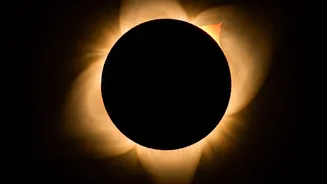
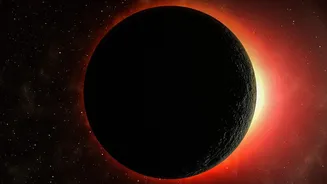
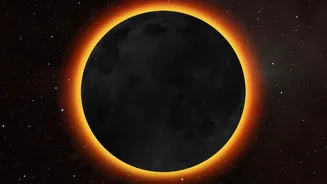
Filled with vengeance against the Sun and Moon for exposing him, Rahu periodically chases and swallows them. This act is believed to cause a solar or lunar eclipse. Since Rahu is only a head with no body, the Sun or Moon eventually emerges from his throat, ending the eclipse. Ketu is said to cause lunar eclipses in a similar fashion. This celestial event is seen as a temporary victory for the demonic forces, casting a shadow of negativity over the earth. Eclipses, called 'Grahanam' in Sanskrit, thus have a negative connotation, suggesting an adverse planetary influence that can create chaos and suffering.
The Inauspicious 'Sutak' Period
The belief in negative energies leads to the observance of the 'Sutak' period, a window of ritual impurity that begins hours before the eclipse. For a solar eclipse, Sutak starts 12 hours prior, and for a lunar eclipse, it begins 9 hours before. This period is considered a time when the atmosphere is contaminated, and extra precautions are needed. Importantly, Sutak rules traditionally apply only to regions where the eclipse is visible. During this time, many activities are forbidden to minimise exposure to these harmful influences.
Prohibitions and Protective Measures
During the Sutak and the eclipse itself, many households follow strict rules. Cooking, eating, and drinking are widely avoided. It is believed that the absence of sunlight increases the proliferation of germs, contaminating food. To protect stored food and water from these supposed negative vibrations, leaves of Tulsi (holy basil) or blades of Darbha grass are placed on them. Temples close their doors, as the idols are considered vulnerable to the negative energies. Activities like sleeping, personal grooming, and starting new ventures are also discouraged. Pregnant women are often advised to stay indoors to protect the unborn child from potential harm.
Astrological and Spiritual Significance
In Vedic astrology, or Jyotish, eclipses are potent events. Rahu and Ketu are not physical planets but are known as 'shadow planets' or lunar nodes—the points where the moon's orbit intersects the sun's path. An eclipse can only happen when the sun and moon align near these nodes. Astrologically, this alignment is seen as a period of turbulence and unpredictability, making it a poor time for major decisions. However, this period is also considered highly powerful for spiritual practices. The thin veil between worlds is believed to make activities like meditation, fasting, and chanting mantras exponentially more effective, offering a chance for accelerated spiritual growth and cleansing of past karma.
Rituals for Cleansing and Renewal
While the eclipse period is seen as inauspicious for worldly activities, it is ideal for spiritual ones. Devotees are encouraged to spend the time in prayer and meditation. A ritual bath is advised at both the start and end of the eclipse. After the Grahan concludes, a final bath is taken, homes are cleaned, and fresh food is prepared to signify a fresh start, cleansed of the eclipse's negative influence. Giving charity (Daan) during or after the eclipse is also considered highly meritorious, believed to multiply blessings and counteract any ill effects.