



Meet the Ghost Particles
To understand the excitement, we first need to talk about neutrinos. These fundamental particles are often called 'ghost particles' for a good reason. They are almost massless, have no electric charge, and can travel through planets, stars, and entire
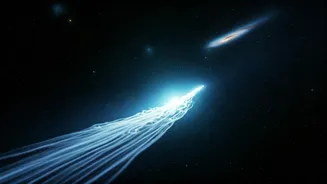
galaxies without interacting with anything. Trillions of them are passing through you every second. While they are incredibly difficult to detect, they are also invaluable cosmic messengers. Unlike light or charged particles, neutrinos are not deflected by magnetic fields, so their path points directly back to their source, carrying secrets from some of the most violent events in the universe. The challenge for scientists has always been figuring out exactly which cosmic powerhouses are creating the most energetic of these particles.
A 'Shadow Blaster' Hiding in Plain Sight
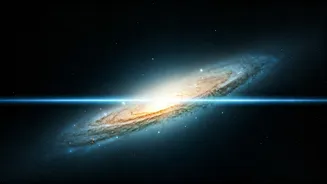
For years, the prime suspects for producing high-energy neutrinos were supermassive black holes at the centers of active galaxies, known as blazars. These cosmic engines gobble up matter and spew out powerful jets of particles. But recent discoveries are pointing to a new and surprising candidate. After the IceCube Neutrino Observatory in Antarctica detected a high-energy neutrino in 2021, astronomers scrambled to find its source. They eventually traced it to a galaxy some 11 billion light-years away. This galaxy, however, showed no signs of a monster black hole. Instead, it was a compact galaxy furiously creating new stars, but it was so obscured by dust that it was almost invisible in optical light. Because of its hidden, powerful nature, researchers nicknamed it the 'Shadow Blaster'.
A Different Kind of Cosmic Engine
The finding suggests a completely different mechanism for creating high-energy neutrinos. Instead of a single supermassive black hole, the engine inside the Shadow Blaster appears to be the collective chaos of intense star formation, known as a starburst. In this incredibly dense and dusty environment, powerful shockwaves from massive stars and supernova explosions could be accelerating particles to incredible speeds. These accelerated particles then collide with the dense gas in the galaxy, producing a shower of particles that includes high-energy neutrinos. The thick dust that hides the galaxy from view is also what helps trap the particles long enough for these collisions to occur, making it a surprisingly efficient neutrino factory.
Why This Discovery Is a Game-Changer
Identifying a new type of source for high-energy neutrinos is a major breakthrough. Observatories like IceCube have detected many of these ghost particles, but the known sources, like blazars, couldn't account for all of them. The existence of starburst galaxies like the Shadow Blaster as neutrino producers could help solve this puzzle. Scientists now estimate that these types of dusty, star-forming galaxies might be responsible for up to 20% of the high-energy neutrino background that we observe across the universe. This opens up a new window for understanding the 'cosmic noon,' a period in the universe's history when star formation was at its peak. It means that some of the universe's most powerful particle accelerators might not be giant black holes, but the frantic, creative energy of star birth itself.