



A Landmark Discovery in the Early Universe
Using the powerful James Webb Space Telescope (JWST), an international team of astronomers was peering into the very distant past. They targeted a galaxy known as J0148-4214, observing light that has traveled for over 12.5 billion years to reach us. This
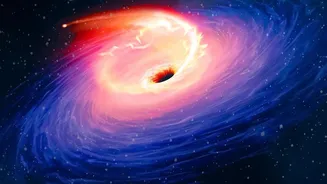
means they were seeing the galaxy as it existed roughly 1.2 billion years after the Big Bang. Their goal was to understand how the first supermassive black holes grew so large, so quickly. The data revealed something peculiar: the light signature from the galaxy's center suggested the frantic, energetic activity of not one, but three distinct, actively feeding black holes.
What is a Black Hole Triplet?
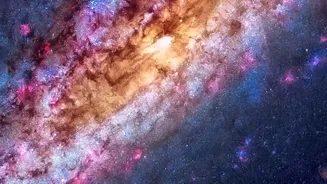
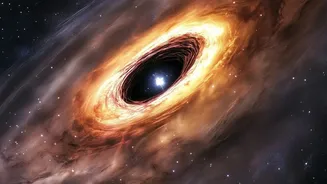
Most large galaxies, including our own Milky Way, have a single supermassive black hole at their core. These behemoths form and grow over billions of years, partly by consuming gas and stars, and partly by merging with other black holes. A black hole triplet is the result of galaxies colliding. In a universe where galaxies are constantly merging, it's expected that their central black holes will eventually meet. Finding a pair is rare enough, but finding three gravitationally bound in the same system is a landmark event. It suggests a triple galaxy merger, where three separate galaxies have collided, bringing their central black holes into a complex and violent gravitational dance.
An Intricate Cosmic Dance
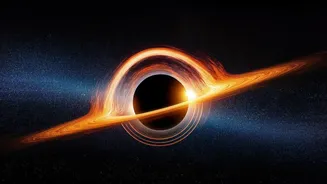
The observations of J0148-4214 show two black holes relatively close together, separated by only about 620 light-years, with a third orbiting further out at a distance of around 5,500 light-years. For perspective, the nearest star to our sun is over four light-years away. The two inner black holes are locked in a tight embrace, and scientists estimate they could merge within a few hundred million years. The presence of the third black hole significantly complicates and accelerates this process. Its gravitational influence can stir things up, helping the inner pair shed energy and spiral toward each other faster, potentially solving a long-standing astronomical puzzle known as the "final parsec problem," where binary black holes are thought to stall before merging.
A Violent Destiny and Gravitational Waves
The ultimate fate of this system is a series of cataclysmic mergers. When two supermassive black holes finally collide, they will merge into an even larger black hole, releasing an unimaginable amount of energy in the form of gravitational waves — ripples in the very fabric of spacetime. Such an event would be among the most violent in the universe. This potential triplet system is an exciting target for future gravitational wave observatories like the Laser Interferometer Space Antenna (LISA). Detecting the gravitational waves from a supermassive black hole merger would be a monumental achievement, opening a new window into understanding gravity and the universe's most extreme events.
Why This Discovery Matters
Finding this possible black hole triplet so early in the universe's history is a game-changer. It supports theories that multiple black hole systems were common in the early cosmos and that mergers were a key driver of black hole growth. For a long time, scientists have wondered how black holes grew to be billions of times the mass of the sun so quickly after the Big Bang. This discovery suggests that frequent, chaotic mergers in a crowded young universe provided a rapid growth pathway. It confirms that the early universe was a dynamic and turbulent place, where galaxies and their central black holes grew up together through spectacular collisions.