


Cosmic Photo Bombs
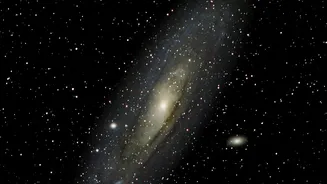
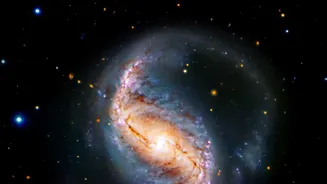
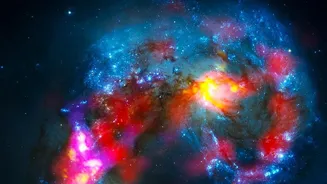
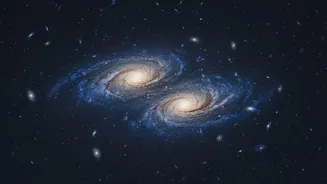
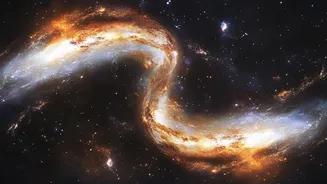
When we gaze into the cosmos, our two-dimensional view from Earth can create spectacular illusions. NASA frequently shares images that appear to show galaxies colliding or interacting, their spiral arms twisting and merging. These images are often captured
by the Hubble Space Telescope, a national asset that has expanded our view of the universe for decades. However, what appears to be a close couple may just be a case of cosmic photo-bombing, where one galaxy is millions of light-years behind another but happens to line up perfectly from our perspective. Distinguishing between these chance alignments and genuine, gravitationally-bound pairs is a crucial task for astronomers seeking to understand how galaxies evolve. A true merger can trigger furious bursts of star formation and permanently alter the structure of the galaxies involved. A chance alignment, while beautiful, is a cosmic coincidence with none of the same physical consequences.
A Tale of Three Pairs
To highlight this very distinction, NASA has showcased several fascinating pairings. Take the galaxy system VV 689, nicknamed the "Angel Wing." Here, two galaxies are clearly in the middle of a collision. The galactic interaction has distorted their shapes into an almost perfectly symmetrical set of wings, confirming they are a true interacting pair. Then there is Arp 143, a duo containing the triangular-shaped NGC 2445 and its companion NGC 2444. The galaxies have clearly passed through one another, with NGC 2444's gravity pulling gas from NGC 2445 and triggering a unique, triangular firestorm of star birth. These are not illusions; they are active, ongoing galactic events.
The Great Deception
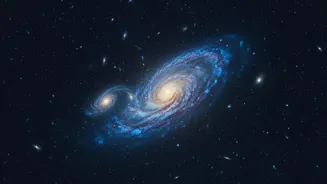
In stark contrast to VV 689 and Arp 143, consider the pair known as NGC 3314. In images, these two spiral galaxies look like they are in the midst of a spectacular collision. However, astronomers have determined this is a trick of perspective. The two galaxies are actually separated by tens of millions of light-years. The only reason they appear to overlap is their chance alignment relative to Earth. This demonstrates how images alone can be misleading. One clue that a pair is not truly interacting is the lack of structural distortion caused by gravitational pull. In the case of NGC 3314, both galaxies appear relatively undisturbed by one another, which is a tell-tale sign of their vast separation.
From 2D Image to 3D Reality
So how do astronomers tell the difference? The key is adding the third dimension: depth. While a telescope captures a flat image, scientists use other tools to measure distance. The primary method is analyzing a galaxy's light spectrum. By measuring how much a galaxy's light has been stretched toward the red end of the spectrum—a phenomenon known as redshift—astronomers can calculate how fast it is moving away from us, and therefore how far away it is. If two galaxies that appear close together in an image have vastly different redshifts, scientists know they are not neighbors but are separated by immense distances along our line of sight. This technique allows them to sort true, interacting pairs from mere visual coincidences.
Why This Distinction Matters
Correctly identifying genuine galaxy mergers is essential for building accurate models of the universe. Galaxy collisions are a fundamental driver of evolution; they are how small galaxies grow into massive ones like our own Milky Way. When galaxies merge, the gravitational chaos and compression of gas clouds can trigger massive waves of star formation, and the resulting super-galaxy is often an elliptical type, different from the original spirals. If astronomers were to count every apparent pair as a true merger, their estimates for how often galaxies collide and how they grow over time would be incorrect. Citizen science projects like Galaxy Zoo have even enlisted the public to help classify these interactions, sorting through hundreds of thousands of images to find scientifically interesting targets for Hubble to investigate further.