









As India’s ambitious Gaganyaan mission moves into its final stages of preparation, a look back at the crucial training of its astronauts reveals the meticulous detail involved—including learning to move in weightlessness.
The Final Frontier for India
The Gaganyaan programme represents
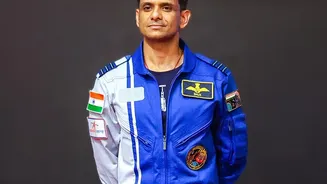
India's historic endeavour to send its own astronauts into space. The objective is to launch a crew of three into a low-Earth orbit of about 400 kilometres for a three-day mission and return them safely to Earth. This monumental undertaking not only showcases the nation's scientific and technological prowess but also positions India among a select group of countries with independent human spaceflight capabilities, alongside the USA, Russia, and China. The four astronaut-designates, all distinguished pilots from the Indian Air Force, are Group Captains Prasanth Balakrishnan Nair, Ajit Krishnan, Angad Pratap, and Wing Commander Shubhanshu Shukla. Their selection marked the beginning of one of the most rigorous training schedules ever undertaken by Indian professionals.
The Russian Connection
A critical phase of the astronauts' preparation took place at Russia’s renowned Yuri Gagarin Cosmonaut Training Center (GCTC) near Moscow. This phase of generic spaceflight training, which concluded in March 2021, leveraged Russia's decades of experience in preparing cosmonauts for the challenges of space. The curriculum was extensive, covering everything from studying the intricacies of spacecraft systems and learning the Russian language to undergoing survival training for various landing scenarios, be it in forests, marshes, or bodies of water. This foundational training laid the groundwork for the more mission-specific modules that the astronauts are now undertaking in Bengaluru.
How to 'Fly' on Earth
The highlight of their Russian training was experiencing simulated weightlessness, a sensation that cannot be truly replicated for long periods on Earth. This was achieved using a specially modified Ilyushin Il-76 MDK aircraft, which functions as a flying laboratory. The aircraft performs a series of parabolic arcs, often called Kepler curves. It climbs steeply at a 45-degree angle, and at the peak of its trajectory, the pilots reduce thrust, causing the plane to enter a phase of freefall. During this descent, which lasts for about 22 to 28 seconds, everything inside the aircraft becomes weightless. The astronauts experienced this brief but intense period of zero gravity up to 15 times per flight, allowing them to adapt to the disorienting environment they will face in orbit.
Training for a Weightless World
Practising movement in microgravity is vital. Simple tasks on Earth become complex in space, where there is no 'up' or 'down' and every action creates an equal and opposite reaction. Recent videos from the training showed the astronauts floating, performing somersaults, and learning to control their movements inside the aircraft's padded cabin. This exercise is not just about floating; it's about training the body and mind to function effectively without the familiar pull of gravity. The experience helps astronauts learn to navigate, handle equipment, and avoid disorientation and space sickness. The training also included simulations for lunar and Martian gravity, preparing the crew for potential future missions beyond Earth's orbit.
The Road to Launch
With the foundational training in Russia complete, the astronauts have been continuing mission-specific training in India at ISRO's Astronaut Training Facility in Bengaluru. This involves working with simulators of the Gaganyaan crew module and familiarising themselves with every aspect of their upcoming flight. Meanwhile, ISRO is in the final phase of preparations for the mission. According to recent updates in November 2026, the components for the human-rated launch vehicle are ready, while work continues on the orbital module. Before the crewed mission takes place, ISRO will conduct a series of uncrewed test flights to validate all systems. The first of these, G1, which will carry the humanoid robot 'Vyommitra', is targeted for launch soon, though a final date has not been confirmed.