



A Tale of Two Cosmic Recipes
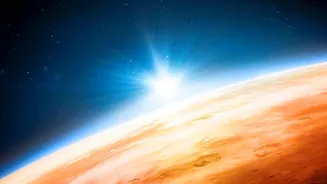
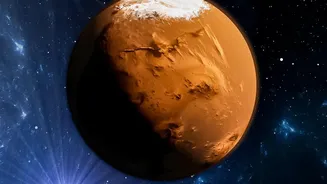
For billions of years, we've looked at Mars as Earth's smaller, rust-coloured sibling. Born from the same swirling cloud of gas and dust around a young Sun, it was natural to assume they were built in a similar fashion. However, a recent study from researchers
at the University of Copenhagen turns this assumption on its head. It reveals that Earth and Mars were created using two very different cosmic recipes. The surprising discovery shows that Earth's bulk came from the gradual accumulation of tiny 'pebbles' by a couple of large planetary 'starters', while Mars was primarily built through the chaotic smash-up of larger, kilometre-sized 'planetesimals'. This fundamental difference in their assembly could be the key to understanding why Earth became a vibrant, water-filled world and Mars became a cold, dry desert.
Planetesimals vs. Pebble Accretion
To understand the finding, we need to know the two main theories of planet formation. The first is 'planetesimal accretion', which is like a cosmic demolition derby. In this model, dust clumps together to form kilometre-sized solid bodies called planetesimals. These then collide and merge over millions of years, violently crashing into each other to form a larger planet. The second method is 'pebble accretion'. Here, much larger Moon-to-Mars-sized bodies called protoplanets act as gravitational vacuum cleaners, sweeping up and accumulating vast quantities of smaller, pebble-sized particles from the surrounding disk of gas and dust. For years, scientists debated which method was dominant. This new study suggests the answer is a hybrid model, but the blend was drastically different for the two planets. Earth appears to have gotten about 75% of its mass from two large protoplanets that grew by sweeping up pebbles, with the other 25% coming from planetesimal collisions. Mars is the complete opposite: roughly three-quarters of its mass came from colliding planetesimals, with pebble accretion playing a much smaller role.
The Clues Are in the Chemistry
How can scientists possibly know what happened 4.5 billion years ago? The answer lies in planetary forensics. Researchers analysed the chemical composition of the crust and mantle of both Earth and Mars, looking for specific 'volatile' elements like zinc, sodium, and potassium. These elements have low boiling points and tend to evaporate and get lost during the high-heat processes of planet formation. By examining the amount of these elements that are 'missing' compared to the original cosmic building blocks, scientists can create a chemical fingerprint of the planet's birth. Using sophisticated computer models, the team calculated which formation scenarios best matched the chemical fingerprints we see today. The results showed that the slow-and-steady pebble accretion process is more efficient at losing these volatile elements. The distinct chemical signatures of Earth and Mars could only be explained if they formed through a different balance of pebble gathering and violent planetesimal collisions.
Why This Changes Everything
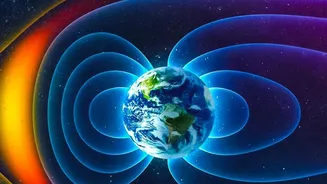
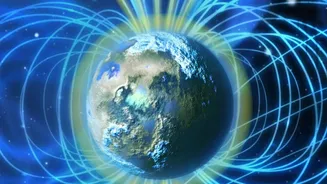
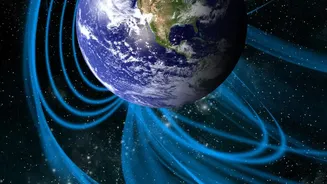
This discovery does more than just rewrite a chapter in our solar system's history; it provides a potential explanation for the profound differences between Earth and Mars. Mars's smaller size, a direct result of its formation path, meant it cooled down much faster than Earth. This rapid cooling likely led to the early shutdown of its magnetic field, which left its atmosphere vulnerable to being stripped away by the solar wind, eventually turning a potentially habitable world into the barren landscape we see today. Earth's formation, dominated by the growth of large protoplanets, allowed it to become much larger, retain its internal heat, maintain a protective magnetic field, and hold onto its atmosphere and oceans. This new understanding suggests that a planet's ultimate destiny—whether it becomes a cradle for life or a desolate rock—is profoundly shaped by the specific mix of building blocks it starts with. It offers a new lens through which to study distant exoplanets and assess their own potential for hosting life.