







The Rise of the 'Water Battery'
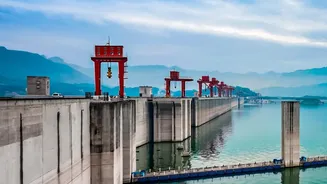
To meet its ambitious goal of 500 GW of non-fossil fuel capacity by 2030, India is turning to a time-tested technology: pumped storage hydropower (PSH). These projects function like giant, natural batteries. During times of surplus power, typically when
solar and wind generation is high, electricity is used to pump water from a lower reservoir to an upper one. When demand peaks and renewables are offline, the water is released back down through turbines to generate electricity. This ability to store and dispatch energy on demand is vital for balancing the grid, which is increasingly strained by the intermittent nature of green power. Companies like JSW Energy and Tata Power are leading the charge, with JSW in particular targeting a massive 40 GWh of storage capacity by 2030, a significant portion of which will come from pumped hydro projects. One such project is a massive 5,200 MW proposal in Maharashtra's Western Ghats.
Why Project Quality Is Non-Negotiable
Achieving these multi-gigawatt targets isn't simply a matter of funding and construction. The technical complexity of PSH demands impeccable project quality. These are long-duration assets, expected to operate for over 40 years, making robust engineering and high-quality components essential. A key factor is the project's 'cycle efficiency'—the ratio of energy generated to the energy consumed during pumping, which typically hovers around 70-80%. Poor design, inferior turbines, or construction flaws can lower this efficiency, hurting the project's economic viability over its lifespan. Moreover, the Indian government is tightening rules for power producers to ensure grid stability, penalizing deviations from scheduled power generation. For PSH developers, this means projects must be reliable and capable of quick start-stop and ramping capabilities to respond to grid demands precisely. Any compromise on quality could lead to operational failures and financial penalties, jeopardizing the very stability these projects are meant to provide.
The High Stakes of Reservoir Selection
Perhaps the most critical and complex variable is the choice of site. PSH projects have extremely stringent geographical and geological requirements. The ideal location needs a significant elevation difference between two points over a short distance, a topography suitable for creating large reservoirs, and stable geology that can hold water without significant seepage. Developers must also secure a reliable water source to perform the initial fill and compensate for evaporative losses. Finding sites that meet all these technical criteria is difficult enough, but the challenges multiply when social and environmental factors are considered. Land acquisition, displacement of communities, and environmental clearances for forest land are major hurdles that can delay or derail projects for years. To minimize these impacts, developers are increasingly exploring 'off-river' or closed-loop systems, which use two purpose-built reservoirs not connected to a major river, thereby reducing ecological disruption. Another strategy involves adding PSH capabilities to existing hydropower dam sites, which can reduce the need for new construction and minimize environmental footprints.
Navigating the Path Forward
Recognizing both the necessity and the difficulty of building out PSH capacity, policymakers are trying to smooth the path forward. The Ministry of Power has released guidelines to promote these projects, and there is a push to create revolving funds to help with the costly upfront work of site investigation and project preparation. However, the industry still faces significant headwinds. Developers have called for greater financial support, such as viability gap funding similar to what is offered for battery storage, and more favourable GST structures to make the projects more financially attractive. As India races to build a grid fit for the future, the success of its PSH ambitions will depend not just on raw investment, but on a sophisticated approach to engineering, meticulous site selection, and a supportive, stable policy environment that encourages quality over pure speed.