



A Moon of Superlatives
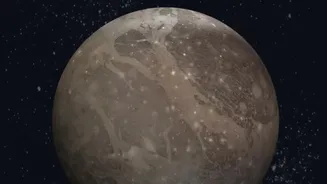
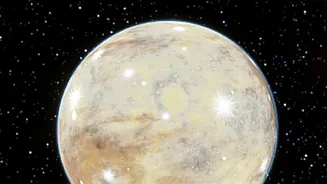
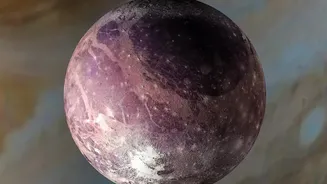
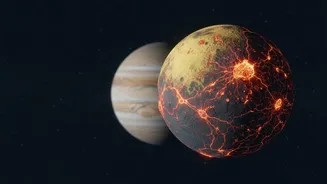
Ganymede is no ordinary moon. It is the largest in our solar system, bigger than the planet Mercury and the dwarf planet Pluto. If it orbited the sun instead of Jupiter, it would easily be classified as a planet. But its size is just the beginning of its unique
resume. Ganymede is the only moon known to generate its own magnetic field. This field, produced by a churning liquid iron core, creates a tiny magnetosphere that shields parts of its surface and generates faint auroras at its poles. This combination of planetary scale and a self-generated magnetic field makes Ganymede a fully differentiated world with complex layers, much like Earth.
An Ocean Deeper Than Any on Earth
Beneath a thick crust of ice, estimated to be about 150 kilometers thick, Ganymede hides a colossal secret: a saltwater ocean. Evidence gathered over decades, from NASA's Galileo and Juno spacecraft to the Hubble Space Telescope, all points to this hidden sea. The most compelling proof comes from observing the moon's auroras; their gentle rocking motion is suppressed by the electrical conductivity of a massive body of saltwater beneath the surface. Scientists estimate this ocean could be 100 kilometers deep—ten times deeper than Earth's oceans—and may contain more water than all of Earth's surface water combined. This makes it one of the largest oceans in the solar system.
The 'Club Sandwich' Model
Unlike Jupiter's other famous ocean moon, Europa, where liquid water is thought to be in direct contact with a rocky mantle, Ganymede's interior may be far more complex. Early models suggested its ocean was trapped between an upper and lower layer of ice, limiting the potential for life-sustaining chemical reactions. However, newer research incorporating the effects of salt and immense pressure suggests a different structure. Scientists now theorize that Ganymede could have multiple layers of ocean and ice stacked on top of each other, like a cosmic club sandwich. Crucially, this model allows for the possibility of a liquid saltwater layer directly touching the rocky mantle at the very bottom, a key ingredient for potential habitability.
A Natural Laboratory for Icy Worlds
Ganymede’s unique combination of features makes it an ideal natural laboratory. Its geology is varied, with ancient, heavily cratered dark terrain alongside younger, brighter grooved regions shaped by tectonic forces. This allows scientists to study the history of the Jupiter system and the processes that shape icy moons over billions of years. By studying its magnetic field, layered ocean, and complex geology, researchers can test and refine their models for how ocean worlds form and evolve. These insights can then be applied to other moons like Europa and Saturn's Enceladus, helping to build a universal understanding of these enigmatic bodies. The European Space Agency's JUICE (Jupiter Icy Moons Explorer) mission, which will eventually orbit Ganymede, is designed to do exactly this.
What It Means for the Search for Life
While Europa is often seen as a more promising candidate for hosting life due to its ocean's direct contact with rock, Ganymede's value is different. It expands our definition of what a potentially habitable world can look like. The 'club sandwich' model reopens the possibility that water-rock interactions—thought to be essential for life's chemistry—could be happening deep within Ganymede. Studying this moon helps scientists understand the full range of conditions under which liquid water can exist and persist. By providing such a complex and accessible example of an ocean world, Ganymede serves as a crucial benchmark, refining the search for life not just within our solar system, but in the countless planetary systems beyond.