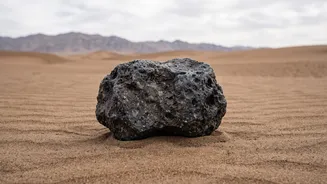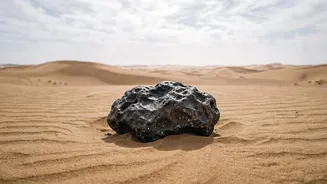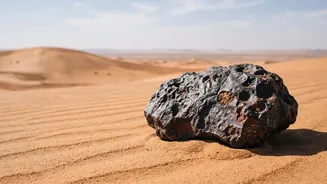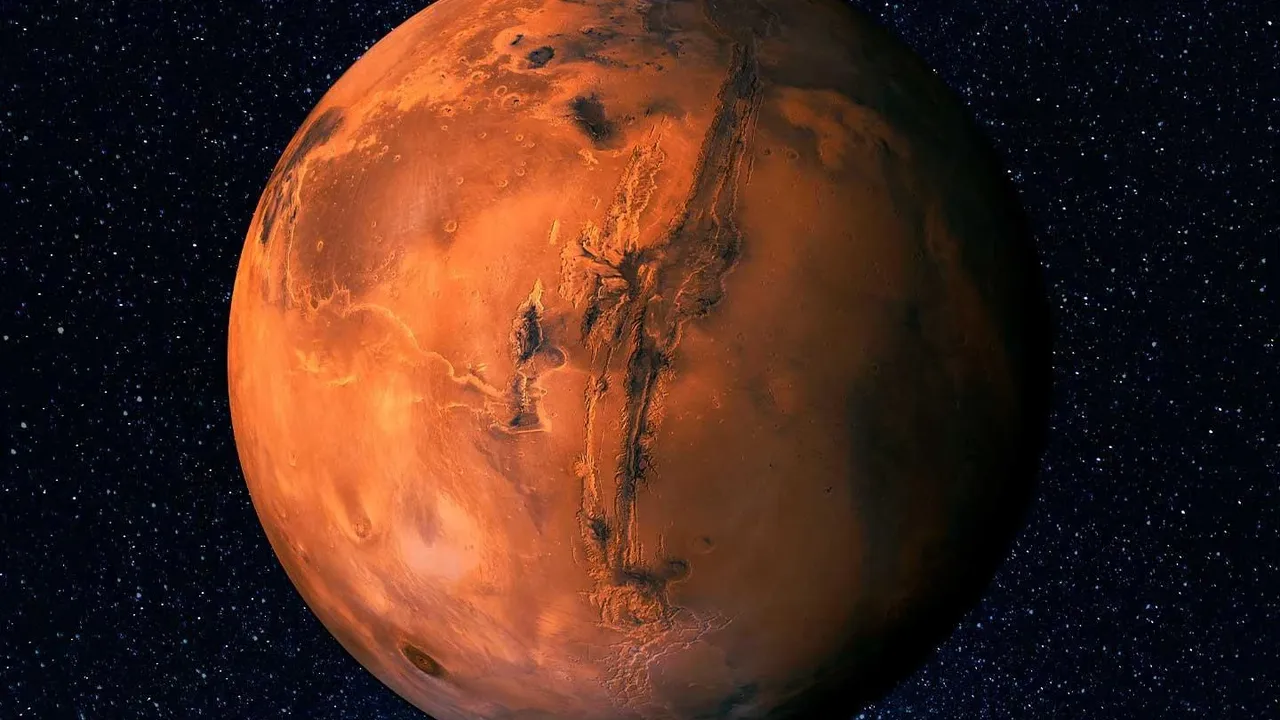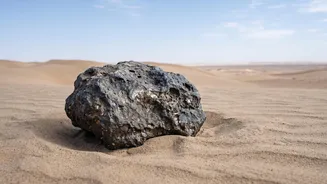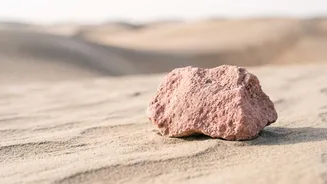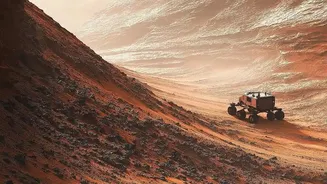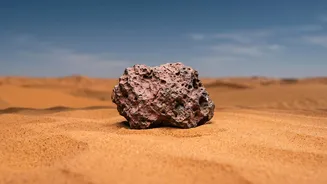




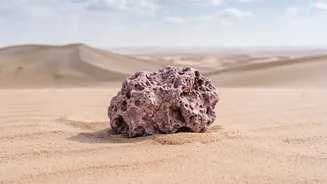
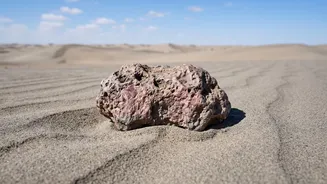
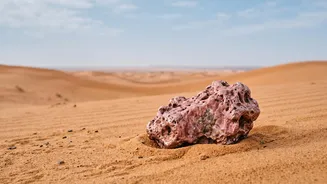
Imagine holding a piece of another world in your hands. A rose-coloured rock, discovered in the Sahara Desert in 2022, has been identified as just that: a messenger from Mars, and one of the oldest ever found.
A Messenger From the Red Planet
In 2022, meteorite hunters came across a remarkable,
nearly two-pound (800-gram) rose-coloured stone on the Teghaza salt plain in Mali. This rock, now named Teghaza 001, didn't reveal its extraordinary secrets immediately. It was only after extensive analysis by NASA-funded scientists that its true identity was confirmed. Using techniques that compare its chemical and mineral makeup to data from Mars missions, researchers verified it was a Martian meteorite—one of only about 435 known to exist on Earth. These rocks are blasted off the Martian surface by powerful asteroid or comet impacts, travel through space for potentially millions of years, and eventually fall to Earth.
A 'Rosetta Stone' for Mars
What makes Teghaza 001 so special, earning it the nickname 'a Rosetta Stone for Mars' from one scientific reviewer, is its incredible age and unique composition. Unlike most Martian meteorites, which are much younger, Teghaza 001 offers a rare window into the Red Planet's infancy. Scientists determined the rock was altered by water around 4.1 billion years ago, which means the rock itself is even older. This places its formation within the first few hundred million years of Mars's existence, a critical period when the planet was just beginning to take shape. For context, this is older than almost any rock found on Earth itself.
Unlocking an Ancient Secret
To determine its age, scientists focused on tiny, durable crystals embedded within the meteorite called zircons. Zircons act as geological time capsules. By analysing the decay of radioactive elements within these crystals, a process known as radiometric dating, researchers can precisely calculate when the rock formed. The team used a novel, high-precision technique that allowed them to analyse individual mineral grains without destroying the larger sample, preserving this precious rock for future study. The analysis confirmed its Martian origin by matching its oxygen isotopes to those found in other Martian rocks.
A Glimpse of a Watery Past
Perhaps the most exciting revelation from Teghaza 001 is the strong evidence of water. Its mineralogy shows that it formed from cooling magma deep within Mars's crust and was later chemically altered by the presence of liquid water. This finding adds to a growing body of evidence that early Mars was not the cold, dry desert it is today, but a world with a much more active water cycle. This interaction between water and rock billions of years ago is crucial for scientists trying to understand if Mars ever had conditions suitable for life. The rock's makeup suggests a complex history, transitioning from a young volcanic planet to one shaped by rock-water interactions.
Building the Martian Story
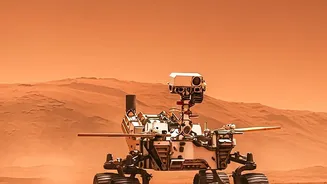
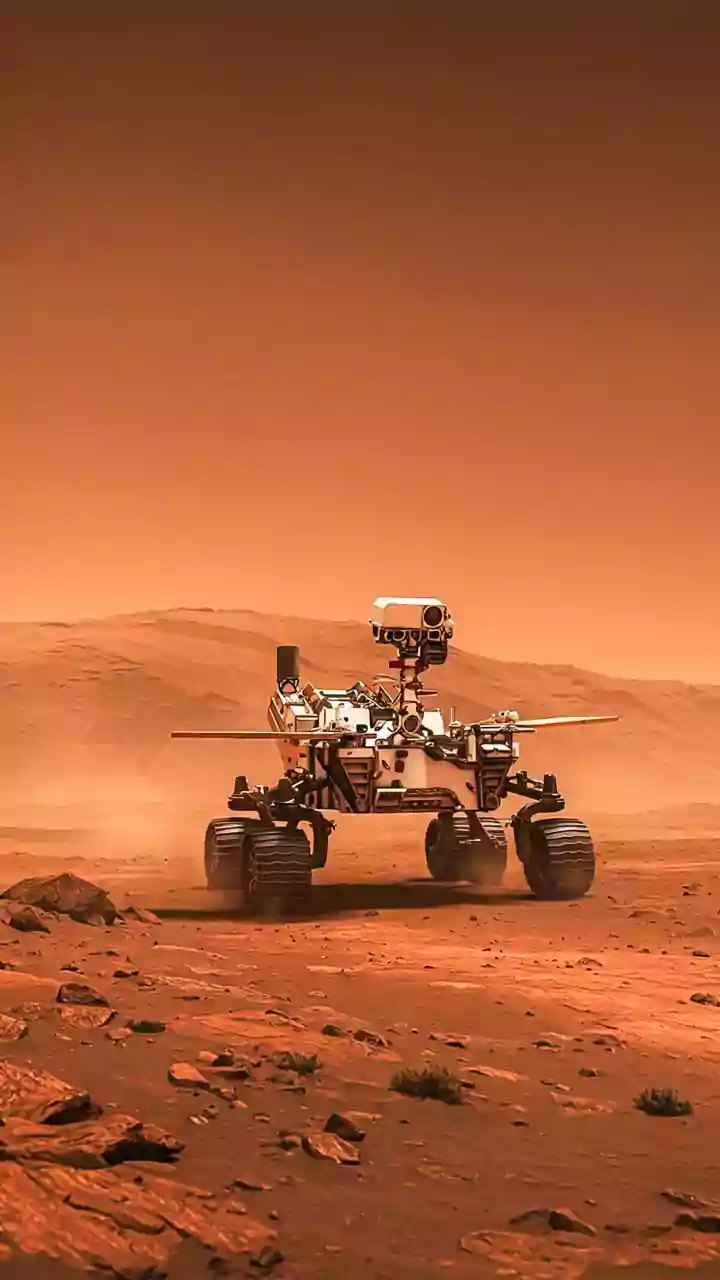
Teghaza 001 joins a very exclusive club of ancient Martian meteorites, including the famous ALH84001 and 'Black Beauty' (NWA 7034). While those samples provided invaluable information, Teghaza 001 is unique because it contains a mix of volcanic minerals that tells a more complete story about the formation of the planet's primary crust. Its composition closely matches observations made by NASA's Mars Reconnaissance Orbiter of the planet's heavily cratered southern highlands, one of the oldest regions on Mars. Scientists have even identified 13 potential locations where the meteorite might have originated, providing a tangible link between a rock in a lab on Earth and a specific region on Mars.