



Where Does Rain Come From?
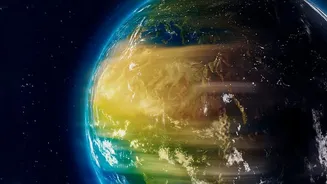
Every raindrop begins a journey. Water evaporates from oceans, lakes, and even plants, rising into the atmosphere as vapour. Winds then transport this moisture, sometimes for thousands of kilometres, before it cools, condenses into clouds, and falls back
to Earth as precipitation. These pathways are the planet's circulatory system, moving freshwater from areas of surplus to areas of need. These systems, often called atmospheric rivers, are responsible for transporting the vast majority of moisture from the tropics toward the poles. For decades, scientists have understood this basic cycle. But climate change is now altering its fundamental mechanics, with profound consequences for global weather.
A Warmer World, A Longer Journey
The core of the change lies in a simple rule of physics: warmer air can hold more moisture. For every 1°C increase in temperature, the atmosphere's capacity to hold water vapour increases by about 7%. As global temperatures rise due to human-caused greenhouse gas emissions, the air is becoming a larger, more absorbent sponge. This supercharged atmosphere doesn't just hold more water; it carries it farther. Recent studies show that moisture is staying aloft for longer periods before it precipitates. One study focusing on the United States found that moisture in some regions now travels 50 to 80 kilometres farther than it did just a few decades ago, remaining in the air for an extra two to four hours. This extended travel time means the source of a region's rainfall is shifting, untethering local weather from its historical patterns.
Rewriting the Global Rainfall Map
This global reshuffling creates a troubling new reality of winners and losers. Regions that once relied on rainfall from nearby land or water bodies may find their supply lines rerouted. The general pattern predicted by climate models is that wet areas will get wetter, and dry areas will get drier. This happens because as moisture-laden air travels further, it bypasses intermediate areas, leading to longer dry spells there. When it finally does rain, it's often in more intense, concentrated downpours, increasing flood risk in the receiving regions. This phenomenon changes the very nature of drought and water security. A region's water supply may become increasingly dependent on land management and evaporation patterns in countries hundreds of kilometres away, introducing new geopolitical complexities to water resource management.
What This Means for the Indian Monsoon
For India, these changes could have significant implications for the all-important monsoon, a system that provides about three-fourths of the country's annual rainfall. The monsoon is a massive system of moisture transport from the Indian Ocean. Climate change is already making the monsoon more erratic, with more intense bursts of rain and longer dry spells in between. An increase in the frequency and intensity of atmospheric rivers, particularly over the north Indian Ocean, could supercharge these extreme events. Some recent weather events have even shown monsoon moisture crossing the Himalayan barrier into Tibet, a rare occurrence suggesting shifts in atmospheric circulation. While a direct link to longer travel distances is still being studied, the underlying principle holds: a warmer atmosphere is amplifying the monsoon's power, making its behaviour harder to predict and its impacts, from floods to droughts, more severe.