

A New Eye on the Cosmos
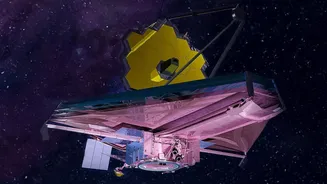
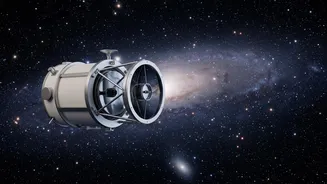
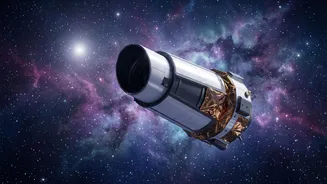
Following in the footsteps of the legendary Hubble and the powerful James Webb Space Telescope, NASA's Nancy Grace Roman Space Telescope represents the next leap in our quest to understand the universe. Launched in August 2026, its mission is to tackle
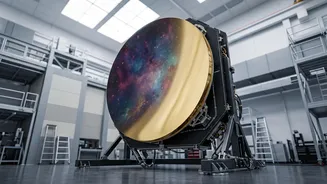
some of the biggest questions in cosmology, including the nature of dark energy and the census of planets beyond our solar system. Named after Nancy Grace Roman, NASA's first chief of astronomy, the telescope boasts a 2.4-meter primary mirror, the same size as Hubble's. However, it's not the mirror size that makes Roman a game-changer; it is its extraordinary field of view.
The Power of a Panoramic View
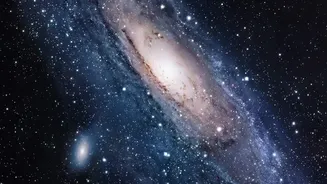
Imagine trying to understand a sprawling city by looking at it through a drinking straw. That's been the challenge for telescopes like Hubble, which provide incredibly deep but narrow views of the sky. The famous Hubble Ultra-Deep Field, which revealed thousands of galaxies, took hundreds of hours to create by stitching together many small images. The Roman Telescope, by contrast, is a panoramic mapping machine. Its Wide Field Instrument (WFI) has a field of view 100 to 200 times larger than Hubble's infrared camera. This means a single snapshot from Roman can cover an area of the sky that would have required a hundred separate images from Hubble. In its lifetime, Roman will survey billions of cosmic objects, creating wide-field maps of the universe with the same sharpness and resolution as its predecessor. This will allow astronomers to move from studying individual objects to analyzing entire cosmic ecosystems.
The 'Question' of Giant Images
This incredible power to capture vast amounts of data is where the "questions" mentioned in the headline arise. These are not questions about the validity of the science, but about the unprecedented logistical and technical challenges of handling the data. Roman's 300-megapixel camera will generate an enormous volume of information. While the James Webb Space Telescope sends back around 270 gigabits of data per day, Roman is expected to downlink approximately 11 terabits daily—a staggering amount that poses a significant challenge for data processing, storage, and analysis. The mission is expected to take over 630,000 exposures during its primary five-year mission alone. This requires a complete rethinking of how astronomical data is managed and accessed. The challenge is no longer just about collecting the light, but about creating a framework that allows scientists worldwide to efficiently mine these colossal datasets for discoveries.
Preparing for a Flood of Discovery
Anticipating this data deluge, NASA and its partners are developing new strategies and infrastructure. This includes creating structured data processing pipelines and release schedules to make the information accessible and usable for the global scientific community. All of Roman's data will be made public immediately, with no proprietary period, to maximize its scientific impact. Community-led groups are already building specialized software and simulation tools to help astronomers navigate the data and target key science objectives, from mapping dark matter to finding new exoplanets using a technique called gravitational microlensing. Roman's surveys will create a multidimensional atlas of the cosmos, providing context for the deep-dive observations of telescopes like Hubble and Webb. This synergy between the panoramic surveyor and the detailed observers will help scientists piece together a more complete picture of the universe, from our solar system to the most distant galaxies.