






A Fading Power Source
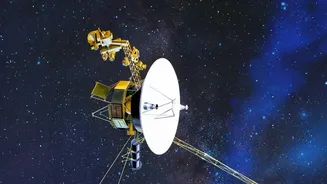
Imagine running a machine with a battery that has been dying for almost half a century. That's the challenge NASA's Jet Propulsion Laboratory (JPL) faces with Voyager 2. Launched in 1977, the probe relies on three radioisotope thermoelectric generators,
or RTGs. These are not batteries in the conventional sense; they use the heat from decaying plutonium to generate electricity. This method has allowed both Voyager probes to operate for decades, far from the Sun. However, the power supply is not infinite. Every year, the decaying plutonium provides about four fewer watts of power. That may not sound like much, but on a spacecraft where every milliwatt is accounted for, it's the difference between discovery and silence. The power margins had become so thin that engineers were facing a difficult choice: shut down another one of its precious science instruments by the end of 2026 to keep the probe alive.
The 'Big Bang' Solution
Engineers at JPL couldn't physically repair the probe, which is a staggering 21.4 billion kilometres away. Instead, they devised a clever software-based solution nicknamed the 'Big Bang'. The plan involved sending a complex series of commands that would, in a single coordinated event, shut down some non-essential hardware, like heaters and a long-unused digital tape recorder, and reroute the saved power. The key challenge was performing this power shuffle while ensuring the spacecraft's critical systems remained warm enough to function in the freezing temperatures of interstellar space, which hover near absolute zero. After months of planning and testing, the command was sent. It took over 19 hours for the signal to travel to the spacecraft and another 19 hours to confirm success. The maneuver worked perfectly, freeing up just enough energy to keep the remaining science instruments running without interruption.
The Science We're Saving
This life-extending maneuver wasn't just an engineering exercise; it was done to protect invaluable science. Voyager 2 is one of only two human-made objects to enter interstellar space, the region beyond the protective magnetic bubble of our Sun. It is our only direct source of data from this unexplored frontier. Over the years, many of its ten original instruments have been shut down to conserve energy. This latest effort saves the remaining three active instruments: the Cosmic Ray Subsystem, the Plasma Wave Subsystem, and the magnetometer. These tools measure high-energy particles from distant stars, analyze plasma waves, and study the magnetic fields that exist between star systems. Each piece of data they return helps scientists build a more complete picture of the galaxy we inhabit. Thanks to the power shift, this unique stream of information will continue for at least another year.
Legacy of an Epic Journey
The Voyager mission has long surpassed its original goals. What started as a four-year mission to study Jupiter and Saturn became a multi-decade grand tour of the outer solar system, with Voyager 2 providing humanity's only close-up views of Uranus and Neptune. Its continued operation is a testament to the durability of 1970s engineering and the ingenuity of the teams that have managed it across generations. The recent power-saving fix is another chapter in this incredible story of problem-solving. NASA plans to apply a similar 'Big Bang' maneuver to Voyager 1, which is even farther away, in the coming months. While the probes cannot last forever, each extra day of data is a bonus for science. They continue their journey as silent ambassadors, carrying the Golden Records—time capsules of Earth's sounds and images—into the vastness of the Milky Way.