







The Planet's Restless Heart
Deep within the Earth lies a dynamic and violent world. Our planet has a solid inner core surrounded by a vast ocean of superheated, swirling liquid iron and nickel—the outer core. This molten ocean is in constant motion. For decades, scientists believed
that the large-scale flow of this liquid metal was dominated by a steady westward drift. This movement is incredibly important, as it acts like a giant dynamo, generating the magnetic field that protects our planet from harmful solar radiation. Without this shield, life on Earth would be exposed to the harshness of space, and our atmosphere could be stripped away. Understanding the behaviour of this hidden engine is therefore crucial to understanding our world.
Our Eyes in the Sky
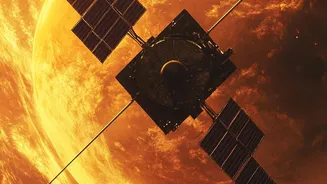
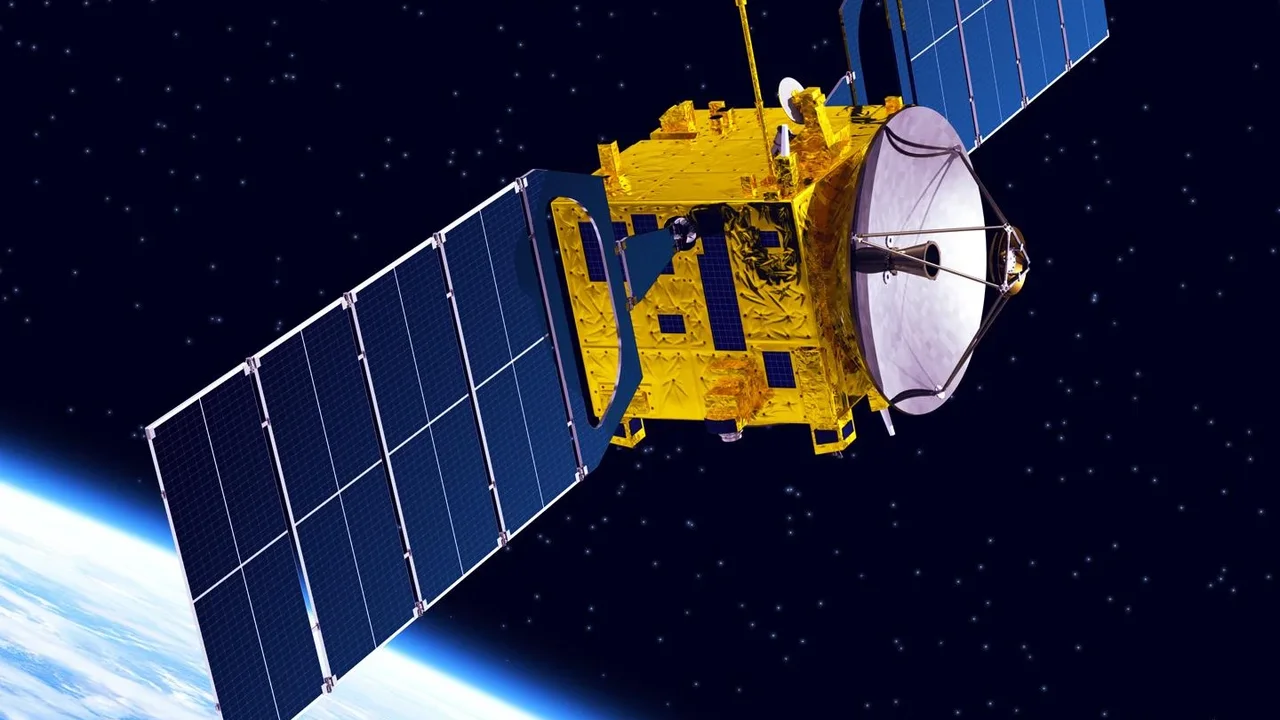
Since we can't send a probe to the core, scientists have to get creative. The key lies in monitoring the very magnetic field the core produces. Tiny fluctuations in this field can offer clues about the motion of the liquid metal deep below. This is where the European Space Agency's (ESA) Swarm mission comes in. Launched in 2013, Swarm is a trio of identical satellites equipped with highly sensitive instruments to measure the strength and direction of Earth's magnetic field with unprecedented precision. By flying in a unique constellation, the satellites can distinguish the magnetic signals coming from the core from those generated by the crust, oceans, and atmosphere. This allows researchers to create detailed maps of the core's behaviour from a vantage point in space.
A Sudden, Unexpected Reversal
By analysing nearly three decades of data from satellites and ground observations, scientists noticed something dramatic. Around 2010, a huge river of molten iron deep beneath the Pacific Ocean, which had been flowing weakly westward, suddenly changed course and began surging strongly to the east. This was a complete surprise and challenged the long-held assumption that the core's flow was relatively stable. The term "core-flow reversal" refers to this specific, regional event, not the entire core flipping its direction. The reasons for this abrupt shift are still a mystery, but it provided a stunning demonstration that the processes deep within our planet can be far more turbulent and unpredictable than previously thought.
What Does This Reversal Tell Us?
This discovery opens a new window into the complex dynamics of Earth's interior. The reversal event has been linked to other deep-Earth phenomena, including a sudden change in the magnetic field known as a "geomagnetic jerk" that occurred in 2017. Scientists are now exploring whether these events are connected to changes even deeper, possibly within the solid inner core itself. This raises fascinating questions about how different layers of our planet interact with each other. The data suggests the strong eastward flow has started to weaken since its peak, leading researchers to wonder if this reversal is a temporary wobble, part of a long, repeating cycle, or the beginning of a new phase for the core's circulation.
A New Era of Deep Earth Discovery
The ability to detect such a significant event from space is a remarkable scientific achievement. It showcases how technology designed to observe our planet from above can be used to probe its deepest, most inaccessible regions. Missions like Swarm, along with others such as CryoSat, have provided a continuous stream of high-precision data that is essential for tracking these changes over time. Instead of relying solely on observatories on the ground, scientists now have a global, uninterrupted view. This allows them to spot rapid, regional changes that might have been missed before, painting a much more detailed and dynamic picture of the engine that powers our planet.