




An Ocean in a Surprising Place
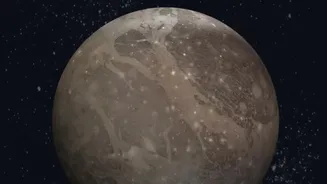
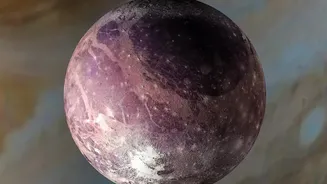
Ganymede is a world of superlatives. It's the largest moon in the solar system, even bigger than the planet Mercury. But its most fascinating feature is hidden beneath a crust of ice estimated to be 150 kilometres thick. There, scientists have found compelling
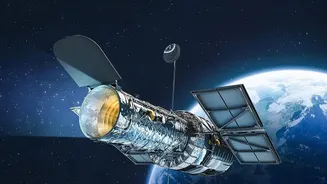
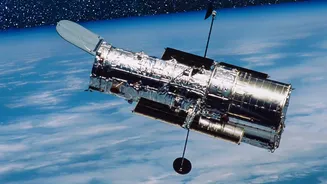
evidence of a vast, saltwater ocean. In fact, this subterranean sea is thought to be 100 kilometres deep and hold more water than all of Earth's oceans combined. The initial clues came from NASA's Galileo spacecraft in the 1990s, which discovered that Ganymede is the only moon with its own magnetic field. Later, observations by the Hubble Space Telescope sealed the deal. By watching the behaviour of Ganymede's auroras—glowing ribbons of gas near its poles—scientists could deduce the presence of a huge, electrically conductive saltwater ocean that influences the moon's magnetic field.
The Key Ingredients for a Habitable World
For a world to be considered potentially habitable, astrobiologists generally agree it needs three key things: liquid water, essential chemical ingredients (nutrients), and an energy source. Ganymede clearly checks the first box with its massive ocean. But it’s the other two ingredients that make it such a compelling subject of study. The energy can't come from the Sun, which is too distant and weak. Instead, it likely comes from tidal heating—the gravitational push and pull from massive Jupiter and its other moons stretches and flexes Ganymede's interior, generating heat. As for nutrients, the crucial question is whether the water is in contact with rock. This water-rock interaction is vital because it can release minerals and chemicals necessary for life to emerge and sustain itself, a process seen at hydrothermal vents on Earth's own ocean floors.
Ganymede's Unique Potential
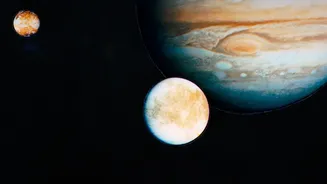
While other moons like Jupiter's Europa and Saturn's Enceladus also have subsurface oceans, Ganymede presents a unique and complex case. Early models suggested its ocean might be trapped between two layers of ice, preventing contact with the rocky mantle below. However, more recent and complex models suggest a wilder possibility: a multi-layered 'club sandwich' structure, with alternating layers of ice and liquid water. Crucially, these models indicate that the lowest layer of liquid water might indeed be in direct contact with a rocky seafloor. This scenario would create a stable environment rich in potential chemical reactions. Adding to its allure is Ganymede's intrinsic magnetic field, which creates a mini-magnetosphere that shields it somewhat from Jupiter's intense radiation, potentially preserving the building blocks of life.
The Mission to Uncover the Truth
These tantalising clues are why the European Space Agency (ESA) has made Ganymede the primary target of its Jupiter Icy Moons Explorer (JUICE) mission. After arriving in the Jupiter system, JUICE will eventually become the first spacecraft to ever orbit a moon in the outer solar system. Its main goal is to characterise Ganymede as a planetary object and potential habitat. Equipped with a suite of advanced instruments, including an ice-penetrating radar, JUICE will map the ocean, measure the icy shell's thickness, and analyse the moon's composition. It will study Ganymede’s unique magnetic field and its complex interaction with Jupiter’s environment. By comparing Ganymede with its neighbours Europa and Callisto, scientists hope to understand the conditions that make icy worlds habitable.