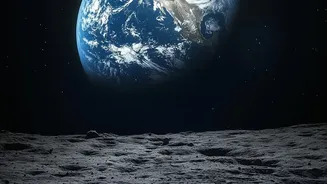





It’s a breathtaking sight: a giant, golden moon looming over the city skyline or peeking through the trees. But if you think the moon is physically larger when it's low in the sky, your eyes are fooling you. It's a powerful illusion.
A Trick of the Mind, Not Physics
The Moon Illusion
has captivated people for thousands of years, with some of the earliest written accounts dating back to ancient Greece. The core mystery is simple: when the full moon is near the horizon, it often appears huge, but hours later, high in the sky, it seems to shrink. You can easily prove this is an illusion. Try holding your thumb out at arm's length next to the horizon moon; you'll find it's surprisingly small. If you take a picture of the moon at the horizon and another when it's overhead with the same zoom settings, you'll see its size in the photos is identical. In fact, due to the geometry of Earth's rotation, the moon is technically about 1.5% farther away when on the horizon, so it should appear slightly smaller, not larger.
What It’s Not: Debunking a Common Myth
A popular misconception is that Earth's atmosphere acts like a magnifying glass for the low-hanging moon. While the atmosphere does affect the moon's appearance, it doesn't make it bigger. It does, however, change its colour. When the moon is near the horizon, its light travels through a much thicker slice of the atmosphere to reach your eyes. This long journey scatters more of the shorter, blue wavelengths of light, allowing the longer, redder wavelengths to pass through. This is why a rising moon often has a beautiful yellow, orange, or even reddish hue. The atmosphere can also cause a slight 'squashed' appearance due to light refraction, but it does not magnify the image.
Theory 1: The Ponzo Illusion
So, if it’s not the atmosphere, what is tricking our brains? One of the most popular explanations is a well-known psychological trick called the Ponzo Illusion. Imagine two parallel lines that converge in the distance, like railway tracks. If you place two identical horizontal bars on these tracks, one 'near' and one 'far', the farther bar will look bigger. Your brain uses the converging lines as a cue for depth and distance. It knows that for an object farther away to appear the same size on your retina as a closer object, it must be physically larger. The Moon illusion might work similarly. When the moon is on the horizon, your brain sees trees, buildings, and hills in the foreground. These objects provide depth cues, telling your brain the moon is very far away. Your brain then 'scales up' your perception of the moon's size to compensate.
Theory 2: The Apparent Distance Hypothesis
Another compelling theory, which is related to the Ponzo idea, is the 'apparent distance' or 'flattened sky dome' hypothesis. This theory suggests that our brains perceive the sky not as a perfect hemisphere, but as a somewhat flattened bowl. We interpret the horizon as being much farther away from us than the point directly overhead (the zenith). When the moon appears on this 'distant' horizon, our brain assumes it must be enormous to occupy the same amount of our visual field as it does when it's in the 'closer' sky overhead. In other words, because your brain thinks the horizon moon is further away, it concludes it must be a larger object. The illusion, in this case, is not that the horizon moon looks big, but that the zenith moon looks unnaturally small.
So, What's the Real Answer?
The fascinating truth is that after centuries of study, there is still no single, universally accepted explanation for the Moon Illusion. Elements of the Ponzo illusion and the apparent distance hypothesis are the leading contenders, and they likely work together. The presence of foreground objects and our brain's ingrained understanding of distance and perspective combine to create this powerful and beautiful effect. The fact that NASA astronauts have reported seeing the illusion in orbit, where there are no trees or buildings for reference, suggests the puzzle is even more complex and deeply rooted in our visual processing. It’s a testament to how our brains actively interpret the world, rather than just passively recording it.