




Just How Massive Is It?
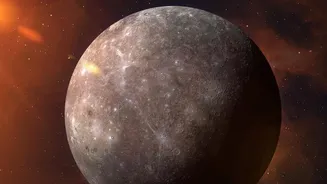
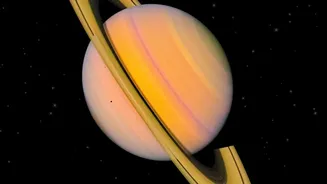
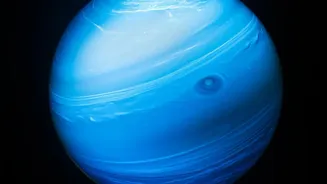
Let's try to put that number into perspective. The Sun’s mass is about 333,000 times that of Earth. If you were to take all eight planets—Mercury, Venus, Earth, Mars, Jupiter, Saturn, Uranus, and Neptune—and combine them with every moon, asteroid, and comet,
they would still only make up the leftover 0.14% of the solar system's total mass. The Sun is so dominant that it's more than 740 times as massive as all the planets put together. This isn't just a case of being the biggest player on the team; the Sun essentially is the team, with everything else amounting to little more than cosmic dust in comparison.
Jupiter: The King of the Leftovers
Within that tiny remaining fraction of mass, one planet reigns supreme: Jupiter. The gas giant is so large that it contains more than twice the mass of all the other planets combined. Of the 0.14% of mass that isn't the Sun, Jupiter accounts for about 70% of it. Put another way, Jupiter's share of the entire solar system's mass is about 0.10%, while all the other planets, moons, and asteroids share the final scraps. Even so, the Sun is still over 1,000 times more massive than Jupiter. This extreme concentration of mass began 4.6 billion years ago when a giant cloud of gas and dust, called a solar nebula, collapsed under its own gravity, pulling most of the material into the centre to form our star.
A Symphony of Hydrogen and Helium
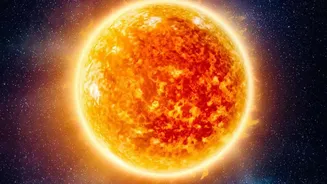
What makes the Sun so incredibly heavy? Its composition is surprisingly simple. It is a giant ball of plasma, primarily made of the two lightest elements: hydrogen and helium. About 73-75% of the Sun’s mass is hydrogen, and about 24-25% is helium. All the other elements, which astronomers collectively call 'metals', make up less than 2% of its mass. The immense pressure and temperature at the Sun's core—around 15 million degrees Celsius—are so intense that they trigger nuclear fusion, a process where hydrogen atoms are fused together to create helium. This reaction releases the enormous amount of energy that powers the Sun and provides light and heat to our entire solar system.
Gravity's Unyielding Grip
The Sun's overwhelming mass is the single most important factor governing our solar system. Its immense gravitational pull acts as a cosmic anchor, holding everything in a predictable and stable orbit. Without this gravitational dominance, the planets would simply fly off into interstellar space. This force is how astronomers were able to calculate the Sun's mass in the first place, long before we could send probes into space. By observing the orbital periods of planets like Earth and applying the laws of gravity first laid out by Isaac Newton and later refined, scientists could accurately 'weigh' the Sun. The same principle—observing how an object's gravity affects things around it—is still used today to calculate the mass of distant stars and even black holes.