






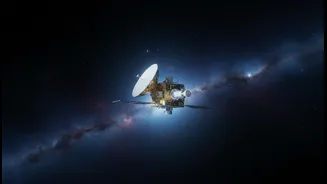


An Explorer's Storied Past
It’s impossible to talk about New Horizons without remembering its greatest hits. Launched in 2006, it remains the only spacecraft to have visited the dwarf planet Pluto and its moons, a feat it accomplished in July 2015. The stunning images it sent back
revealed a world of incredible complexity, with vast nitrogen glaciers, towering water-ice mountains, and hints of a subsurface ocean. But it didn't stop there. On New Year's Day 2019, the probe flew past Arrokoth, a snowman-shaped object in the Kuiper Belt. This encounter gave humanity its first close-up look at one of the solar system's primordial building blocks, an object largely unchanged since the dawn of the planets.
Why the Long Nap?
After such groundbreaking encounters, the probe began a long cruise through the vast, dark expanse of the Kuiper Belt. To conserve power, reduce operational costs, and extend the life of its components, mission controllers at the Johns Hopkins Applied Physics Laboratory (APL) routinely place New Horizons in hibernation. This latest nap was its longest ever, lasting 321 days. While most of its systems were powered down, it wasn’t completely asleep. Three of its science instruments continued to gather data around the clock, passively monitoring the solar wind, the charged particle environment, and the dust of the outer solar system. Weekly status reports sent back to Earth confirmed all was well during its long rest.
Awake and Reporting for Duty
On June 23, 2026, acting on commands sent nearly a year earlier, the spacecraft's internal computer initiated the wake-up sequence. Confirmation of its healthy status traveled for 8 hours and 52 minutes to reach Earth from its position approximately 9.5 billion kilometers (5.9 billion miles) away. Now, the mission team has a busy schedule. First, they will download all the health and safety data to ensure the probe is in perfect shape. After that, they will begin the slow process of retrieving the precious scientific observations its instruments collected while it was hibernating.
The New Frontier: An Observatory at the Edge
So, what is the next frontier? Unlike its previous objectives, New Horizons is not preparing for another close flyby of a specific object. Although scientists are using powerful new observatories to search for a potential new target, its current mission has shifted focus. The probe's new purpose is to act as a unique deep-space observatory. From its vantage point in the Kuiper Belt, far from the Sun's glare and the dust of the inner solar system, it can make observations no other mission can. In the coming weeks, it will begin studying the distribution of hydrogen gas in the outer heliosphere—the vast bubble of influence created by our Sun.
A Journey into Interstellar Space
This new mission phase is about understanding the very boundary of our solar system. As New Horizons travels outward at nearly 480 million kilometers (300 million miles) per year, it is collecting invaluable data on the heliosphere and its interaction with the wider galaxy. Scientists predict it could cross the 'termination shock'—the boundary where the solar wind dramatically slows—as early as 2029. This will make it only the third functioning spacecraft, after the legendary Voyagers, to enter interstellar space. With more advanced instruments than its predecessors, New Horizons is poised to give us our most detailed look yet at the threshold between our solar home and the vast ocean of stars beyond.