



What is a 'Ghost Particle'?
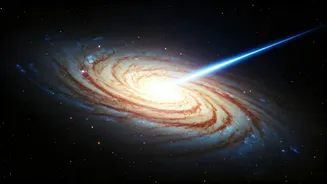
Before we get to the Shadow Blaster, let's talk about its ghostly messenger. The discovery began with a single, high-energy particle called a neutrino, detected by the IceCube Neutrino Observatory buried deep in the Antarctic ice on September 22, 2021.
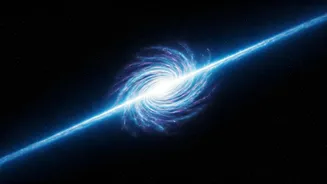
Neutrinos are fundamental subatomic particles, often called 'ghost particles' because they have almost no mass, no electric charge, and barely interact with other matter. They can travel billions of light-years across the cosmos in a straight line, passing through planets, stars, and entire galaxies without being deflected. This makes them perfect cosmic messengers; if you can detect one, it points directly back to its source. The challenge, however, is that their elusive nature also makes them incredibly difficult to detect.
Hunting for the Source
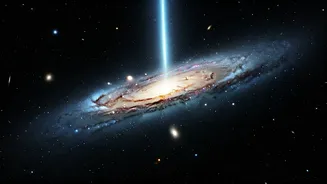
The single neutrino, logged as IC 210922A, sent astronomers on a cosmic detective hunt. They pointed powerful telescopes, like the Atacama Large Millimeter/submillimeter Array (ALMA) in Chile, towards the patch of sky the neutrino came from. There, they found an object that was nearly invisible in optical light but blazed brightly at submillimeter wavelengths. The object, officially named JCMT0402−0424, was a galaxy so shrouded in interstellar dust that it was effectively hidden from conventional view. Capturing its hidden nature and immense energy, the research team gave it the informal nickname 'Shadow Blaster.'
Inside the Shadow Blaster
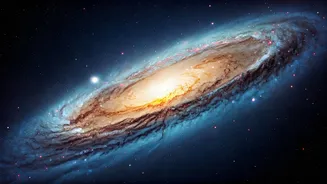
Located about 11 billion light-years away, the Shadow Blaster is not just any galaxy. It is what's known as a starburst galaxy, a system undergoing an astonishingly rapid phase of star formation. Initially, astronomers suspected a supermassive black hole might be powering its immense energy output, as has been the case with other known neutrino sources. However, observations showed no evidence of an active black hole. Instead, the data pointed to extreme star formation within a dense, compact core only about 1,500 light-years across. This kind of dense, gas-rich environment has long been theorized to act as a natural particle accelerator, capable of producing high-energy neutrinos when cosmic rays collide with the dense gas.
A Cosmic Magnifying Glass
Studying a galaxy 11 billion light-years away in such detail would normally be impossible. However, the team had a stroke of luck thanks to a phenomenon predicted by Albert Einstein: gravitational lensing. A massive galaxy happened to lie directly between Earth and the Shadow Blaster. Its immense gravity bent and magnified the light from the Shadow Blaster, acting like a natural cosmic telescope. This effect created brighter, more enlarged images, allowing astronomers to peer into the galaxy's hidden core and confirm the absence of a black hole and the presence of intense starburst activity.
Why This Discovery Matters
This discovery, published on June 17, 2026, in the journal Nature Astronomy, is significant because it provides the first strong evidence linking a high-energy neutrino to a dusty, star-forming galaxy. Until now, the few known sources were active galaxies powered by supermassive black holes. The Shadow Blaster shows that these starburst galaxies, common in the early universe during a period known as 'cosmic noon', could be a major, previously unaccounted-for source of the high-energy neutrinos that pepper the universe. This opens a new window into understanding the most energetic events in the cosmos and helps solve the long-standing mystery of where these 'ghost particles' come from.