


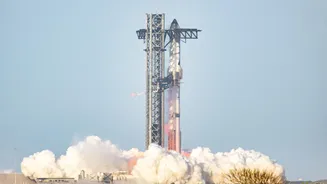
What Just Happened?
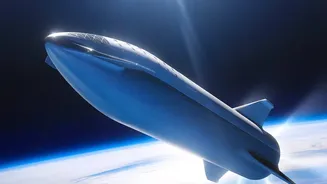
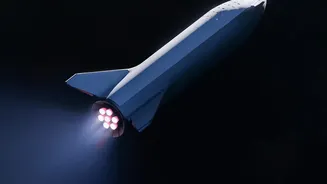
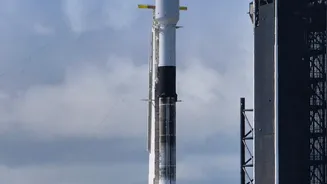
On its 15th test flight, SpaceX's Starship system successfully launched, sending its upper stage, known as Ship 42, into orbit. After completing a remarkable 22-hour mission that included deploying 26 Starlink satellites, the spacecraft performed a precise,
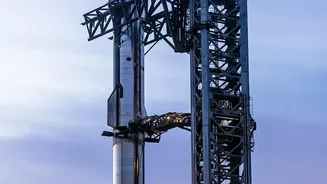
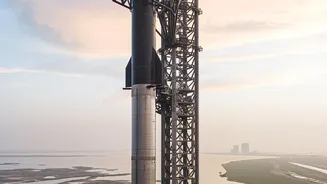
fiery re-entry through Earth's atmosphere. The climax came as the massive vehicle descended toward its launch site in Texas. Instead of landing on legs, it was deftly caught by a pair of giant mechanical arms on the launch tower, a system nicknamed 'Mechazilla'. While this was a historic first for an orbital upper stage, the mission saw mixed results; the Super Heavy booster that launched the ship aborted its own landing attempt and was lost in the Gulf of Mexico.
The 'Chopsticks' of the Space Age
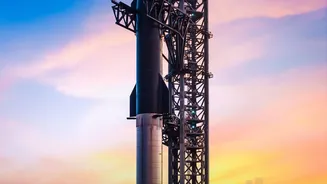
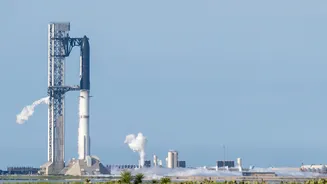
The Mechazilla tower is one of the most audacious pieces of engineering ever built for spaceflight. Standing taller than a 40-story building, the tower is equipped with two enormous, hydraulically-powered arms often called 'the chopsticks'. These arms are designed to perform an incredibly precise maneuver: catch a returning rocket booster or ship as it slows to a near-hover using its own engines. The system relies on a suite of advanced sensors, including LiDAR and high-resolution cameras, combined with machine learning algorithms to track the descending vehicle with millimeter-perfect accuracy. The goal is to eliminate the need for heavy landing legs on the vehicle itself, saving mass that can be used for payload instead. By catching the rocket, the tower also places it directly back onto the launch mount, ready for inspection and a rapid relaunch.
The Holy Grail of Reusability
For decades, rockets were an expendable technology. Imagine throwing away a car after a single drive; that's been the standard model for space access. SpaceX has been chipping away at this problem for years, first by landing and reusing its Falcon 9 boosters. Starship aims to achieve the 'holy grail': a fully and rapidly reusable system. By recovering both the Super Heavy booster and the Starship upper stage, the cost of a launch drops dramatically to little more than the cost of propellant and operations. The economics are staggering. An expendable rocket can cost hundreds of millions of dollars to build. A reusable one that can fly multiple times a day spreads that cost across many missions, fundamentally changing what's possible in space. This catch proves the hardest part of that vision—recovering the stage that actually goes to orbit—is possible.
More Than Just a Catch
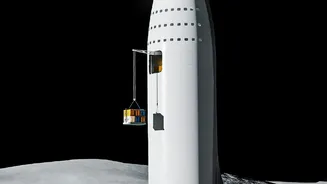
The 22-hour duration of this mission was as significant as the catch itself. Previous flights were much shorter, but a nearly day-long journey in orbit demonstrates the vehicle's endurance and reliability in the harsh environment of space. This is a critical prerequisite for future missions. A trip to Mars, for instance, will take months, not hours. Even missions closer to home, like deploying satellites or servicing a future Moon base for NASA's Artemis program, require the ship to operate for extended periods. By proving the ship can function for a long duration, deploy a payload, and then return safely, SpaceX has shown Starship is maturing from an experimental prototype into a true operational spacecraft.
The Road to Mars Runs Through Texas
Every Starship test, whether a spectacular success or a rapid unscheduled disassembly, is a step toward Elon Musk's ultimate goal of making humanity a multi-planetary species. To establish a self-sustaining city on Mars, you need to launch an incredible amount of mass—cargo, habitats, supplies, and people. This requires a launch system that is not only massive but can be reused quickly and affordably, like an airline. The successful catch of the Starship upper stage is arguably the most critical technological hurdle cleared on that path. While the loss of the booster shows there is still work to be done, the ability to recover the orbital stage intact moves the entire program into a new phase. It's a shift from asking 'if' it can be done to figuring out how quickly it can be done again.