



Humanity's successful deflection of an asteroid in NASA's DART mission was a landmark achievement. But a sobering new study from Sandia National Laboratories warns we're not ready for the real thing just yet. Here’s why a cosmic game of billiards is far
more complicated than it looks.
A Planetary Wake-Up Call
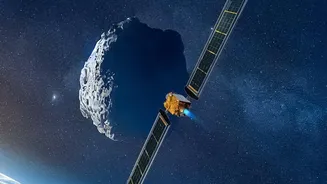
In 2022, NASA’s Double Asteroid Redirection Test (DART) made history by intentionally crashing a spacecraft into an asteroid moonlet, Dimorphos, successfully altering its orbit. For the first time, we proved that deflecting a celestial body was possible, moving the concept of planetary defence from science fiction to scientific fact. The mission was celebrated globally as a monumental first step. However, a recent study published in the scientific journal Icarus by researchers at Sandia National Laboratories in the US serves as a critical reality check. The findings suggest that while we can hit an asteroid, predicting what happens next is dangerously uncertain without far more sophisticated computer modelling.
The Problem with Lumpy Rocks
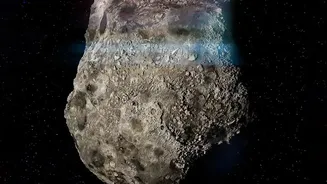
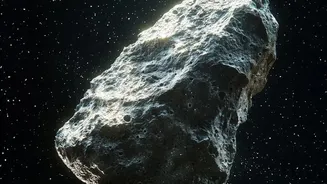
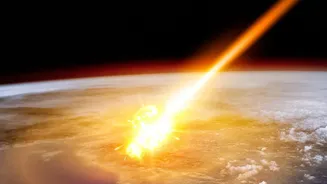
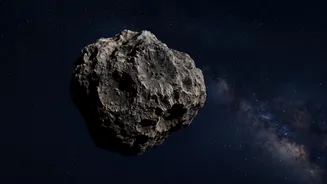
For years, simulations of asteroid deflection made a convenient simplification: they treated asteroids as perfect spheres. The reality is that most asteroids are lumpy, irregular, and look more like potatoes than marbles. The Sandia study, led by physicist Nathan Moore, highlights just how much this matters. Using a powerful new algorithm, the team simulated a potential defence scenario: using a nearby nuclear detonation to blast one side of an asteroid with X-rays. This vaporises surface material, creating a powerful push to nudge the asteroid off course. The results were startling. Depending on which side of the irregular asteroid was targeted, the effectiveness of the push varied by a factor of up to five. In short, hitting the wrong spot could mean the difference between a successful deflection and a failed one.
From Nudge to Nightmare Scenario
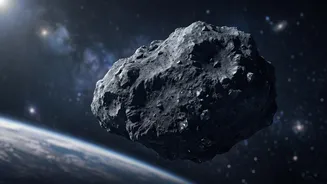
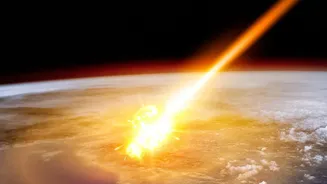
The composition of asteroids adds another layer of complexity. Many are not solid, monolithic rocks but are instead 'rubble piles'—loose collections of boulders, gravel, and dust held together by weak gravity. These bodies are notoriously tricky. A kinetic impactor, like the DART spacecraft, might be absorbed by a rubble pile much like a beanbag absorbs a punch, making it difficult to move. An even greater risk is fragmentation. A poorly calculated push could shatter a rubble pile into a cloud of smaller, but still potentially devastating, pieces. This could turn a single, trackable threat into a shotgun blast of objects heading for Earth, multiplying the danger. The Sandia study cautions that while their new model can simulate surface breakup, predicting whether the entire asteroid will fracture is a critical next step that requires more research.
Building a Better Crystal Ball
The breakthrough at the heart of the Sandia study is a new algorithm that is over 1,600 times faster than previous methods. This incredible speed allows scientists to run complex simulations using realistic, lumpy asteroid shapes—something that was previously too computationally expensive. By combining different high-fidelity codes, the model provides the most detailed look yet at how an irregular asteroid responds to an energy pulse. This isn't just an academic exercise. For a real threat, knowing which side of an asteroid to target is crucial. These improved simulations can help mission planners make better decisions, test various scenarios, and identify what kind of observational data—like a complete 3D shape model—is most vital to collect before attempting a deflection.