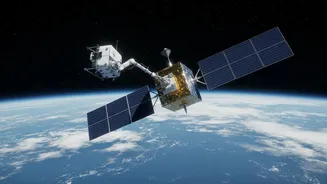








Not Your Usual MEPs
When you hear ‘MEPs’, you might think of politicians in Brussels. In this cosmic context, however, the acronyms stand for something entirely different. The mission is led by the MRV, or Mission Robotic Vehicle, a highly advanced robotic spacecraft built
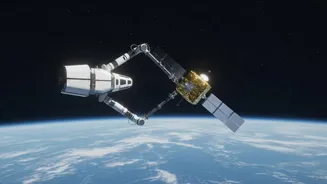
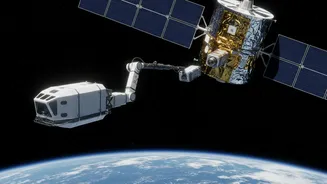
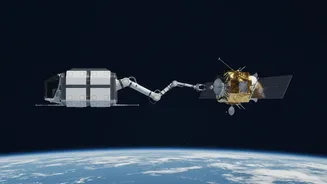
by American defence and aerospace giant Northrop Grumman. Its companions are three MEPs, which are not parliamentarians but Mission Extension Pods. Think of the MRV as a very sophisticated roadside assistance truck for space, complete with robotic arms. The MEPs are its cargo: compact ‘jetpacks’ filled with propellant. Together, they form a servicing team designed to find satellites that are running low on fuel and give them the ability to keep working for years longer. This isn’t a test run; it is the beginning of a new commercial service for the space industry.
The High Cost of an Empty Tank
The skies, particularly the valuable geosynchronous orbit about 36,000 kilometres above Earth, are crowded with essential satellites for communication, broadcasting, and weather forecasting. These satellites are incredibly expensive to build and launch, yet their operational lifespan is often dictated by a simple factor: fuel. They use propellant for tiny adjustments to maintain their precise position, a task known as 'station-keeping'. When the fuel runs out, the satellite, with its perfectly functional and valuable electronics, is often forced into retirement and becomes another piece of hazardous space debris. This is a huge economic waste. Satellite operators must commission and launch a costly replacement, while a perfectly good asset is abandoned. The in-orbit servicing mission aims to solve this exact problem, offering a way to refuel satellites without having to bring them back to Earth or replace them entirely.
A Robotic Refuel in Orbit
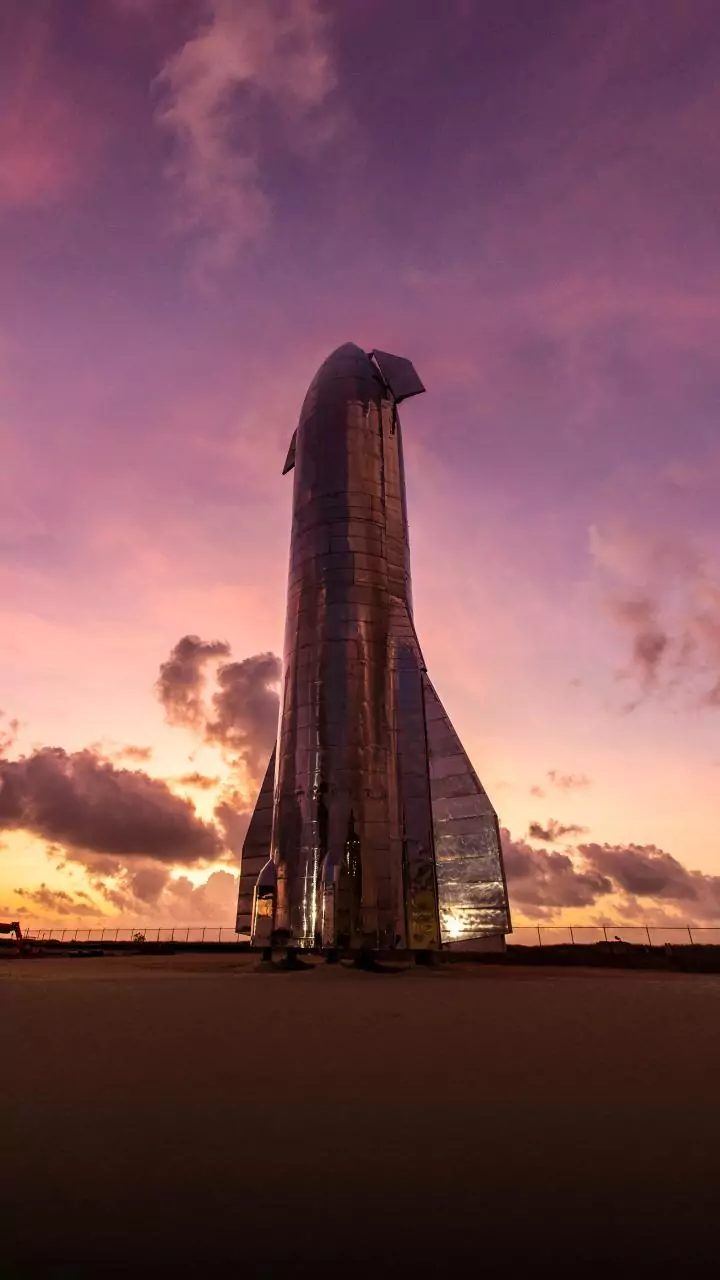
The process is a masterpiece of space robotics. After its launch in late July 2026 aboard a SpaceX Falcon 9 rocket, the MRV will spend about a year travelling to its operational altitude in geosynchronous orbit. Once there, its first job will be to approach a client's satellite. Using its advanced robotic arms, which were developed with support from the U.S. defense agency DARPA, the MRV will inspect the client spacecraft. After a successful check-up, it will carefully install one of the Mission Extension Pods onto the aging satellite. This MEP then takes over all propulsion and orbit control duties for the host satellite. This service can add an estimated six to eight years of operational life, allowing the satellite to continue generating revenue and providing services long after its internal fuel supply is exhausted. After installing a pod, the MRV will move on to its next client.
Pioneering a Circular Economy in Space
This mission by Northrop Grumman’s subsidiary, SpaceLogistics, is more than just a clever engineering feat; it represents a fundamental shift in how we approach space operations. It is a crucial step towards creating a circular economy in space, where assets are maintained, repaired, and reused rather than simply discarded. This approach, often called In-space Servicing, Assembly, and Manufacturing (ISAM), is seen as essential for the long-term sustainability of space activities. The ability to service satellites could eventually lead to missions that can perform complex repairs, upgrade components, or even assemble large structures in orbit. For now, the first commercial clients for this life-extension service include global satellite operators SES and Optus, signaling strong industry demand for a more sustainable and cost-effective way to manage orbital fleets.