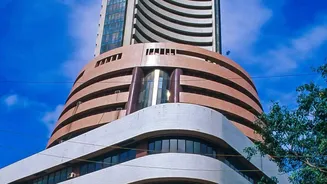








The Short-Term Squeeze
Over the past twelve months, Indian financial markets have faced significant headwinds. A combination of factors, including global uncertainty, rising interest rates in developed markets, and foreign institutional investors (FIIs) pulling capital out
of emerging markets, has created a challenging environment. These outflows weaken market liquidity and put pressure on the prices of even the largest, most stable companies. On some days, markets have seen steep corrections, with banking and metal stocks facing significant selling pressure. For instance, the large-cap fund category on average saw a decline of 5.80% in the last year. This environment means that even the biggest and most reputable mutual funds, which are required to invest at least 80% of their assets in India's top 100 companies, are not immune to these broad market downturns.
A Tale of Two Timelines
This is where the story splits. While the one-year report card for many large-cap funds shows modest or even negative returns, the five-year picture is dramatically different. For example, some prominent large-cap funds have posted one-year returns hovering between 0% and 5%. In some cases, a few have even shown slight negative returns, such as -0.89% or -5.40%. However, when you zoom out to a five-year horizon, these same funds often showcase impressive annualized returns, frequently ranging from 9% to over 13%. For instance, funds like Invesco India Large Cap Fund and Nippon India Large Cap Fund have five-year annualized returns of around 12% and 13.9% respectively. This stark contrast highlights a fundamental principle of equity investing: markets are volatile in the short term but have historically trended upwards over the long term.
The Power of Compounding and Patience
The divergence between one-year and five-year returns is the perfect illustration of why financial advisors often preach patience. The five-year gains are not just from market growth; they are supercharged by the power of compounding—where your returns start generating their own returns. Selling in a panic during a down year not only locks in your losses but also robs you of the opportunity to participate in the eventual recovery and subsequent growth. Historical data shows that periods of market correction are often followed by strong rebounds. The investors who benefit the most are those who stay invested, or even continue their Systematic Investment Plans (SIPs), through the volatility. Continuing to invest during a downturn means you are buying fund units at a lower price, which can significantly amplify your returns when the market turns around.
What the Experts Foresee
Despite recent volatility, many market analysts remain optimistic about the long-term prospects for the Indian economy. Projections point to India becoming the world's third-largest economy by 2027, with corporate earnings expected to grow robustly. Morgan Stanley, for example, has a base-case scenario where the BSE Sensex could see a significant upside by the end of 2027, driven by sustained domestic growth and healthy corporate earnings. Analysts believe that despite short-term pressures from factors like crude oil prices and global interest rate policies, the structural growth story of India remains intact. This outlook is supported by strong domestic investment flows, including record contributions to SIPs, which provide a steady stream of capital to the markets.