
Our Solar System's Protective Bubble
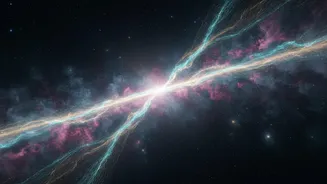
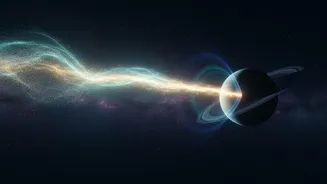
Our solar system exists within a giant bubble called the heliosphere, which is inflated by a constant stream of charged particles from the Sun known as the solar wind. This bubble isn't just empty space; it acts as a crucial shield, protecting Earth and
the other planets from a significant amount of harsh galactic cosmic radiation coming from interstellar space. The outer boundary of this bubble, where the Sun's influence wanes and the vast expanse of the galaxy begins, is called the heliopause. For decades, scientists have been trying to understand the precise shape and dynamics of this boundary, which is thought to be billions of kilometres away. The Voyager 1 and 2 spacecraft pierced this boundary in 2012 and 2018 respectively, giving us our first direct samples, but they were only two points in a vast, unexplored region.
Meet IMAP: The New Cosmic Cartographer
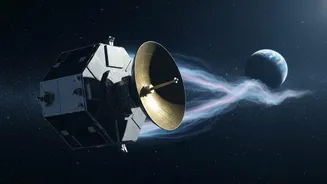
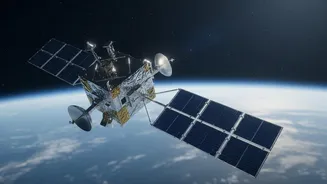
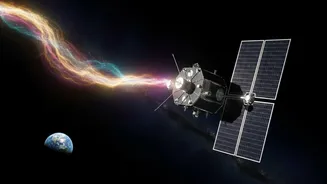
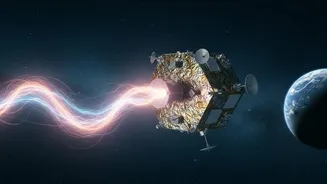
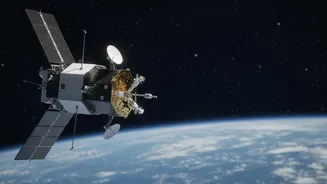
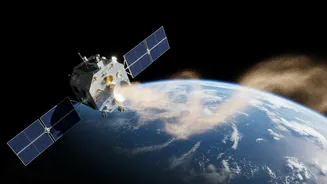
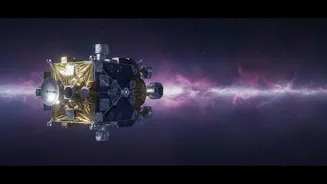
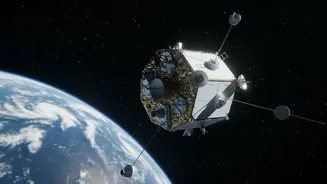
Enter NASA's Interstellar Mapping and Acceleration Probe, or IMAP. Launched in late 2025, IMAP is a dedicated mission designed to map this boundary region in a way no spacecraft has before. Unlike the Voyager probes that had to travel for decades to reach the edge, IMAP is positioned about 1.5 million kilometres from Earth towards the Sun, at a gravitational balance point called Lagrange Point 1. From this vantage point, it acts like a celestial cartographer, intercepting special particles that travel inward from the distant heliopause. By studying these cosmic messengers, IMAP can build a global map of the interaction between the solar wind and the interstellar medium, helping scientists understand the structure and behavior of our solar system's shield.
Decoding Energetic Neutral Atoms
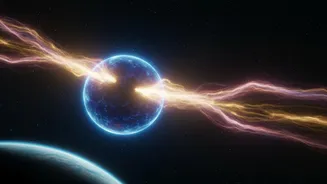
The key to IMAP's technique lies in its ability to detect 'energetic neutral atoms,' or ENAs. Out at the heliosphere's edge, the hot, charged particles of the solar wind collide with cold, neutral atoms from interstellar space. In a process called charge exchange, an electron can jump from a neutral atom to a charged solar wind particle. This turns the once-hot solar particle into a high-speed neutral atom—an ENA. Because these ENAs are now electrically neutral, they are no longer deflected by magnetic fields. They zip away from the collision site in a straight line, carrying information about where they came from and the conditions of that distant region. Several of IMAP's ten instruments, including IMAP-Hi, IMAP-Lo and IMAP-Ultra, are specifically designed to catch these ENAs and measure their direction and energy, effectively taking a picture of an otherwise invisible boundary.
What the First Data Reveals
The mission's first public science data, released in early August 2026 from seven of its instruments, represents a 'first light' for this new way of seeing our cosmic neighborhood. While detailed scientific papers are yet to come, the initial data confirms that all instruments are performing well, capturing the flow of solar wind particles and, most importantly, the faint but information-rich signals of ENAs. These early results provide the first pieces of a comprehensive, all-sky map of the heliosphere's edge. The data allows scientists to begin tracing the structure of the boundary, observing how it 'breathes' in response to the Sun's activity and how it filters the galactic cosmic rays that stream toward us from the rest of the Milky Way.
A New Era for Heliophysics
Beyond its primary goal of mapping the heliosphere, IMAP also serves as an advanced space weather monitor. Its instruments provide real-time data on the solar wind, offering valuable warnings about solar storms that could threaten satellites, power grids, and astronauts in space. The decision to make the mission's data public so early on is also significant. It invites the global scientific community to dive in, collaborate, and potentially accelerate the pace of discovery. By giving more researchers access to this unprecedented information, NASA is fostering a wider effort to understand the dynamic environment our solar system travels through and the protective bubble that makes life on Earth possible.