




The Promise of a Martian Lake
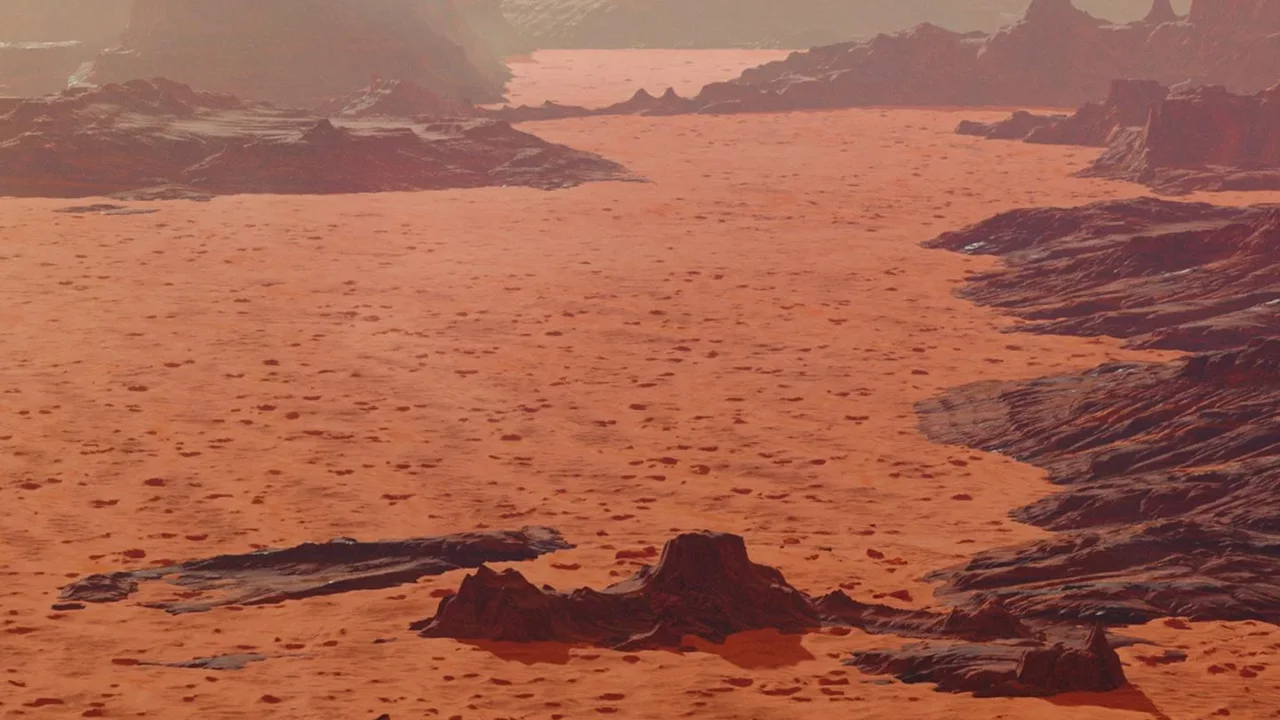
When NASA chose Jezero crater as the landing site for its Perseverance rover, the logic was simple and compelling. From orbit, the 28-mile-wide crater looked like the perfect remnant of a watery past, complete with a fan-delta where a river once deposited
sediments. Scientists were particularly interested in a feature called the "margin unit," a band of rock tracing the crater's inner rim that was believed to be the ancient shoreline. The orbital data showed strong signals of carbonates, minerals that, on Earth, are excellent at preserving signs of life. The expectation was that Perseverance would find sedimentary rocks—layers of mud and sand laid down by the lake—that could hold fossilised evidence of Martian microbes.
A Surprising Volcanic Twist
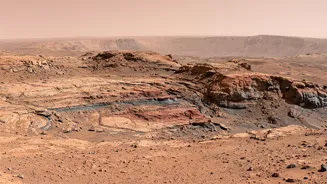
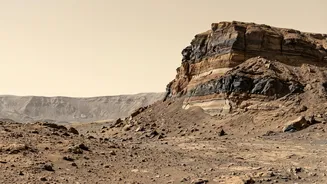
However, when Perseverance arrived at the margin unit in 2023 and began analysing the rocks with its advanced instruments, it sent back a surprise. Instead of the expected sedimentary layers, the rover found igneous rocks, rich in a mineral called olivine. Igneous rocks are formed from cooling magma, either deep underground or from surface volcanic activity. This discovery, detailed in recent studies, fundamentally changed the understanding of Jezero's history. The foundation of what was thought to be a placid lakeshore was actually born of fire, not water. Using instruments like the SuperCam, which analyses mineral composition with a laser, the science team confirmed that these rocks formed as magma cooled slowly, long before any lake existed.
A Crossroads of Watery Events
While the rocks weren't formed by the lake, they still had an incredible story to tell about water on Mars. Igneous rocks, it turns out, are excellent record-keepers. Analysis revealed that these volcanic rocks had been altered by water not just once, but in at least three distinct episodes. First, carbon dioxide-rich groundwater seeped through cracks, depositing the carbonate minerals that had been spotted from orbit. Later, the rocks were exposed to different water, possibly from the Jezero lake itself or changing groundwater conditions. Finally, a third event involved hotter, hydrothermal fluids surging through younger fractures, leaving behind mineral veins that suggest a hot spring-like system was once active in the crater.
What This Means for the Search for Life
This discovery doesn't diminish the chances of finding signs of past life; it makes the search more specific. The margin unit wasn't a simple shoreline but a complex geological 'crossroads' where different water systems interacted over a long period. Each of these watery environments, from groundwater to potential hydrothermal vents, could have been a habitable niche for microbial life. The carbonate minerals, while not formed by the lake as initially thought, are still present and are known for their ability to preserve biosignatures. This complex history helps scientists better understand where to look for the most promising samples for Perseverance to collect. These core samples are destined for a future mission that will return them to Earth, where they can be studied in detail for definitive proof of ancient Martian life.